










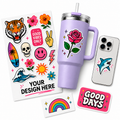


UV DTF stickers get most of their attention as a tumbler decoration, but the same waterproof, durable transfer works well on plenty of other hard surfaces — laptops and phone cases included. The application basics carry over, but each surface has its own quirks worth knowing before you apply.
Why UV DTF Works on Hard Surfaces
UV DTF stickers are printed with a UV-cured ink layer that's genuinely durable and waterproof once applied — unlike a standard printed vinyl sticker, they don't need a separate laminate layer to resist scratching and fading, since the UV-cured coating is part of the transfer itself. That's what makes them a reasonable option on a surface people handle constantly and expose to friction, moisture, and temperature swings — exactly the conditions a laptop or phone case sees daily.
Laptops
- Surface material matters: aluminum and hard plastic laptop lids take a UV DTF sticker cleanly; textured or soft-touch finishes (some rubberized laptop coatings) can affect how well the adhesive grips over time, so it's worth checking your specific laptop's lid finish before committing to placement
- Avoid vents and hinges: placement over ventilation openings or right at the hinge line invites heat exposure and repeated flexing that shortens the life of any sticker, UV DTF included
- Clean before applying: laptop lids pick up oil from hands and surfaces constantly — a clean, dry surface (isopropyl alcohol wipe, fully dried) gives the adhesive a real bond instead of sticking to a thin layer of residue that will let go early
Phone Cases
- Hard cases vs. soft/silicone cases: UV DTF adheres more reliably to hard plastic or polycarbonate cases than to soft silicone or TPU cases, since flexible materials stress the sticker's edges every time the case bends slightly during normal handling
- Camera cutout awareness: plan your design layout around camera bumps and cutouts before ordering size, rather than sizing a sticker that then has to be trimmed around hardware after the fact
- Case removal: a sticker applied directly to the case (not the phone itself) means it comes off cleanly with the case if you swap cases later, without residue on the actual phone
How UV DTF Compares to Standard Vinyl on These Surfaces
Standard printed vinyl stickers typically need a laminate overlay to get comparable scratch and water resistance, adding a production step and often a slightly thicker, less refined finished edge. UV DTF's built-in durability gives a similar protection level without that extra layer, generally with a thinner, cleaner edge profile — which matters more on a small, frequently-handled surface like a phone case than it would on something larger like a car window.
Application Tips
- Apply at room temperature — cold surfaces reduce initial adhesive tack and can lead to edges lifting sooner
- Press firmly from the center outward to avoid trapping air bubbles, particularly on a curved laptop lid edge or a case with a slight camber
- Avoid repositioning once pressed — UV DTF adhesive bonds quickly, and repeated lifting to reposition weakens the bond compared to placing it correctly the first time
Frequently Asked Questions
Do UV DTF stickers work on phone cases?
Yes, and they adhere more reliably to hard plastic or polycarbonate cases than to soft silicone or TPU cases, since flexible materials stress the sticker's edges during normal handling.
Should I clean my laptop before applying a UV DTF sticker?
Yes — a clean, dry surface (an isopropyl alcohol wipe, fully dried) gives the adhesive a real bond instead of adhering to hand oils or residue that shortens the sticker's life.
How does UV DTF compare to standard vinyl stickers on hard surfaces?
UV DTF has built-in scratch and water resistance from its UV-cured coating, without needing a separate laminate layer the way standard vinyl often does — generally giving a thinner, cleaner finished edge.
Design your sticker sheet on the UV DTF Stickers page.


