









UV DTF vs. Vinyl Decals: What's the Difference?
UV DTF and vinyl decals are both pressure-sensitive adhesive products that stick to hard surfaces — but they are produced through entirely different processes, perform differently in real-world conditions, and suit different applications. Choosing the wrong one for a job means peeling graphics, wasted material, or a finished product that doesn't meet customer expectations.
UV DTF (Ultraviolet Direct-to-Film) transfers are printed using UV-cured inks onto a clear PET film with a built-in adhesive layer. The design is transferred to the surface by pressing the film down and peeling it back, leaving a thin, ink-only layer bonded to the substrate. There is no carrier film visible on the finished product — just the graphic itself sitting flush against the surface.
Vinyl decals are cut from pre-colored adhesive vinyl using a plotter or die cutter, or printed onto printable vinyl using an inkjet or solvent printer and then laminated. The finished decal includes a vinyl carrier layer, ink (for printed decals), and a pressure-sensitive adhesive backing. The vinyl film remains visible and tactile on the surface after application.
The clearest way to distinguish them: UV DTF leaves only ink on the surface — no film. Vinyl decals leave a film layer. That difference drives almost every performance and aesthetic distinction between the two.
How UV DTF Transfers Work
UV DTF printing uses a flatbed or roll UV printer to lay down ink — including a white underbase and a clear protective topcoat — directly onto a specialized PET transfer film. The inks cure instantly under UV light as they print, producing a fully hardened, ready-to-apply graphic in a single pass. No heat, no press, no drying time required.
The design is printed onto UV DTF film in layers: a clear adhesive base coat, the full-color design with white underbase, and a protective topcoat. All layers cure under UV light during printing. The result is a rigid, fully cured transfer on the film.
Apply
No heat press needed. The transfer film is placed ink-side down onto the target surface and pressed firmly by hand or with a squeegee. The adhesive layer bonds to the surface on contact with pressure.
Peel
The carrier film is peeled back slowly, leaving only the cured ink layer adhered to the surface. The finished result is a smooth, film-free graphic that sits flush against the substrate — no edges to catch, no vinyl layer visible.
How Vinyl Decals Work
Vinyl decals come in two main types: cut vinyl and printed vinyl. Both involve a vinyl film carrier that remains on the surface as part of the finished product.
Cut Vinyl Decals
A plotter cuts the design shape from solid-colored adhesive vinyl. The excess material is weeded away by hand, and the finished decal is transferred to the surface using a transfer tape. Cut vinyl is limited to solid colors — no gradients, no photographs, no fine detail beyond what the blade can cut cleanly.
Printed Vinyl Decals
Full-color designs are printed onto printable vinyl using an eco-solvent, solvent, or UV printer, then laminated with a clear protective film, and cut to shape. Printed vinyl can reproduce photographs and complex artwork but adds thickness and a visible film edge around the design. Application typically uses transfer tape for repositioning and bubble-free placement.
UV DTF vs. Vinyl Decals: Head-to-Head Comparison
Both products serve the custom graphics market, but they have meaningfully different strengths. This comparison covers the factors that matter most when deciding which to use for a given project.
| Factor | UV DTF Transfers | Vinyl Decals |
|---|---|---|
| Finish appearance | Film-free, flush to surface | Visible film layer and edges |
| Color capability | Full color, gradients, photos | Full color (printed); solid only (cut) |
| Application method | Press and peel — no tools needed | Transfer tape, squeegee, bubble removal |
| Application skill required | Low — forgiving and fast | Moderate — bubbles and misalignment are common |
| Best surfaces | Smooth hard surfaces (tumblers, glass, acrylic, phone cases) | Flat surfaces, vehicles, windows, walls |
| Curved surface performance | Excellent — conforms easily | Limited — vinyl resists tight curves |
| Outdoor durability | Good (1–3 years depending on UV exposure) | Excellent (3–7 years with cast vinyl) |
| Dishwasher safe | Hand wash recommended | Hand wash recommended |
| Minimum order quantity | 1 unit — no minimums | Varies — setup costs favor larger runs |
| Production speed | Fast — print and apply same day | Moderate — laminating, weeding, and cutting add time |
| Repositionability | Limited once applied | Easier with transfer tape during install |
| Feel on surface | Nearly flush, minimal texture | Raised vinyl edge noticeable to touch |
Where UV DTF Transfers Win
UV DTF is the superior choice in several specific scenarios. Understanding these use cases helps you source the right product the first time.
- Drinkware and tumblers: UV DTF conforms to curved cylindrical surfaces without wrinkling or lifting at the edges — vinyl struggles on tight curves and frequently develops edge lift on bottles and cups.
- Premium branded merchandise: The film-free finish looks more professional and permanent than a vinyl decal with a visible edge — critical for high-end product presentation.
- Small runs and one-off custom orders: No setup costs, no minimum quantities, and fast turnaround make UV DTF economical at quantities of 1–50 units where vinyl setup costs aren't justified.
- Complex full-color artwork: Photographs, gradients, and intricate designs print in full fidelity with no weeding, no color limitations, and no layering required.
- DIY and non-professional application: UV DTF requires no tools, no squeegee technique, and no bubble management — press, peel, done. Significantly lower skill floor than vinyl application.
- Phone cases, acrylic panels, and smooth hard goods: UV DTF bonds cleanly to glass, acrylic, metal, and coated plastics without the edge-lifting problems that plague vinyl on glossy or polished surfaces.
Where Vinyl Decals Win
Vinyl is not obsolete. For certain applications it remains the better — sometimes the only — practical choice.
- Vehicle graphics and wraps: Cast vinyl is engineered for long-term outdoor automotive use with 5–7 year durability ratings. UV DTF is not designed for constant UV bombardment, temperature cycling, and car washes.
- Large-format flat graphics: Window decals, wall graphics, floor stickers, and signage at sizes above 12 inches are cost-effective in vinyl. UV DTF gang sheets are optimized for smaller decorative items.
- Removable and repositionable applications: Removable vinyl adhesive allows clean removal from walls, windows, and surfaces without residue — useful for seasonal promotions, rentals, and temporary signage.
- High-volume production runs: At quantities of 500+ identical decals, vinyl's per-unit cost drops significantly. UV DTF gang sheets are efficient for mixed small designs, less so for massive identical runs.
- Textured or semi-rough surfaces: Aggressive-adhesive vinyl can bond to textured surfaces like powder-coated metal, brick-effect panels, or textured plastic that UV DTF won't adhere to reliably.
A practical rule of thumb: if the item fits in your hand and lives indoors, UV DTF is usually the better choice. If it's large, flat, outdoors, or on a vehicle, vinyl is more appropriate.
Surface Compatibility: What Each Works On
| Surface | UV DTF | Vinyl Decal |
|---|---|---|
| Stainless steel tumblers | Excellent | Limited (edge lift on curves) |
| Glass (bottles, mugs, windows) | Excellent | Good (flat glass only) |
| Acrylic / plexiglass | Excellent | Good |
| Painted metal (vehicles) | Fair | Excellent |
| Plastic phone cases | Excellent | Good |
| Powder-coated surfaces | Fair | Good |
| Wood (sealed/finished) | Good | Good |
| Walls (painted drywall) | Not Recommended | Good (removable vinyl) |
| Fabric / textiles | Not Recommended | Not Recommended |
| Textured / rough surfaces | Not Recommended | Fair (aggressive adhesive) |
Durability and Care: What to Expect
Both products are durable under the right conditions. Failure almost always comes from mismatched application — using a product outside its intended use case rather than from inherent weakness in the material.
UV DTF Durability
UV DTF transfers are rated for 1–3 years of normal indoor and light outdoor use. The UV-cured ink layer is scratch-resistant and water-resistant. For drinkware, hand washing is recommended — extended dishwasher exposure degrades the adhesive bond over time. Direct, prolonged outdoor UV exposure (think: items left in a car window or outdoor furniture) will fade the ink faster than indoor use. Protect the surface from sharp abrasion and harsh chemical cleaners.
Vinyl Decal Durability
Cast vinyl with UV-laminate is rated for 3–7 years outdoors depending on sun exposure, climate, and surface prep. Calendered vinyl is cheaper but typically lasts 2–4 years. For indoor applications, both types last significantly longer. Vinyl is more vulnerable to peeling at edges if not properly squeegeed during installation or if applied to a dirty or oily surface. Laminated printed vinyl is more durable than unlaminated print-and-cut output.
Care for Both Products
For UV DTF on drinkware: hand wash with mild soap, avoid scrubbing the decorated area, and do not soak. For vinyl decals: wipe clean with a damp cloth, avoid prolonged exposure to harsh solvents (acetone, bleach), and do not pressure wash directly over the graphic. Both products benefit from clean, oil-free surface prep at the time of application — this is the single most impactful factor in long-term adhesion for either product.
Cost Comparison: UV DTF vs. Vinyl Decals
Cost per unit varies significantly based on quantity, design complexity, and whether you're ordering finished transfers or producing in-house. Here's how the economics typically break down for buyers ordering ready-made products.
| Scenario | UV DTF | Vinyl Decal |
|---|---|---|
| Single custom item | Cost-effective — no setup fee | Higher relative cost — setup time not amortized |
| 5–25 units, mixed designs | Efficient via gang sheet layout | Moderate — weeding and laminating adds labor |
| 100+ identical units | Competitive | Increasingly cost-effective at scale |
| Large format (12"+ designs) | Less efficient | Vinyl is purpose-built for this |
| Full-color complex artwork | No color surcharge | No color surcharge (printed vinyl) |
UV DTF gang sheets let you nest multiple designs on a single sheet, reducing cost per unit significantly when ordering several different designs at once. If you're decorating a variety of items in small quantities, a gang sheet is almost always more economical than ordering individual vinyl decals per design.
Which Should You Choose?
The right product depends on the surface, the quantity, the environment, and the finish quality you need. Use this as a decision guide.
- Decorating tumblers, cups, or drinkware → UV DTF
- Vehicle graphics or long-term outdoor use → Vinyl
- Small batch branded merchandise with full-color artwork → UV DTF
- Window decals, wall graphics, or removable signage → Vinyl
- Phone cases, acrylic signs, glass, or hard smooth goods → UV DTF
- High-volume identical decals at 500+ units → Vinyl
- Applying yourself with no tools or experience → UV DTF
- Custom event merchandise, vendor booth products, or resale items → UV DTF
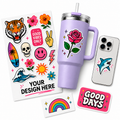
If you're ready to order UV DTF transfers, the UV DTF gang sheet builder lets you lay out multiple designs on a single sheet for the lowest cost per unit. Pre-made designs are also available as UV DTF stickers ready to apply immediately.
Frequently Asked Questions
UV DTF transfers leave only a cured ink layer on the surface — no film, no visible edge. The carrier peels away after application. Vinyl decals leave the vinyl film itself on the surface as part of the finished product, creating a slightly raised, tactile edge around the design. UV DTF is applied by hand with no tools; vinyl typically requires a squeegee and transfer tape for clean installation. UV DTF excels on curved and smooth hard surfaces; vinyl is better suited for flat surfaces, vehicles, and large-format outdoor applications.
Yes — UV DTF is the preferred choice for tumblers and drinkware. Vinyl struggles to conform to the curved surface of a cylinder without wrinkling, and the edges of vinyl decals on curved surfaces frequently lift over time, especially with washing. UV DTF transfers flex around the curve during application and bond flush to the surface with no exposed edges to catch or peel. The film-free finish also looks more professional and permanent on premium drinkware.
UV DTF transfers are not recommended for regular dishwasher use. The high heat, prolonged water exposure, and harsh detergents in a dishwasher cycle degrade the adhesive bond over time, leading to edge lifting or graphic loss. Hand washing with mild soap is recommended to maximize longevity. This is the same care instruction that applies to most decorated drinkware regardless of decoration method — including vinyl, sublimation, and screen printing on coated tumblers.
UV DTF transfers last 1–3 years under normal indoor use with proper care. Cast vinyl decals with UV laminate are rated for 3–7 years outdoors. For indoor or light-use applications — drinkware, phone cases, branded merchandise — UV DTF durability is more than adequate. For permanent outdoor signage, vehicle graphics, or anything subjected to constant sun and weather exposure, cast vinyl is the longer-lasting choice. Neither product is a good candidate for dishwashers or prolonged chemical exposure.
UV DTF transfers can handle light and occasional outdoor exposure but are not engineered for permanent outdoor use. Items that live outside full-time — like outdoor signage, vehicle graphics, or equipment labels — will see UV DTF fade and degrade faster than a properly laminated cast vinyl decal. For items that go outdoors occasionally (a water bottle taken hiking, a tumbler used at an outdoor event), UV DTF holds up fine. For anything with continuous outdoor exposure, use vinyl.
UV DTF transfers require a smooth, non-porous surface for reliable adhesion. Textured surfaces — rough powder coat, matte rubberized finishes, raw wood, concrete, brick — do not provide enough flat contact area for the adhesive to bond fully. Smooth or lightly textured surfaces like polished stainless steel, glass, glossy or satin-finish acrylic, and coated plastics all work well. When in doubt, test a small transfer on the specific surface before ordering a full run.
UV DTF transfers adhere well to smooth, hard, non-porous surfaces including stainless steel, glass, acrylic, polished aluminum, coated plastic, sealed wood, ceramic, and most phone cases. They work on both flat and moderately curved surfaces — the flexibility of the transfer film allows it to conform around cylindrical items like tumblers and bottles. They do not work on fabric, textured surfaces, raw porous materials, or surfaces with waterproof or silicone coatings.
UV DTF transfers can be removed, but they are not designed to be repositioned. Once applied and the carrier film is peeled, the adhesive bond is set. Removal typically requires careful use of a plastic scraper and isopropyl alcohol to soften the adhesive layer. On some surfaces, residue may remain. Unlike removable vinyl which is specifically engineered for clean removal, UV DTF should be considered a semi-permanent application — position it correctly the first time.
A UV DTF gang sheet is a single printed film sheet that contains multiple designs nested together to maximize the printable area and reduce cost per transfer. Instead of ordering each design individually, you arrange several different graphics on one sheet and pay for the sheet as a whole. This is the most cost-effective way to order UV DTF transfers when you need multiple designs or a variety of sizes. The individual transfers are cut apart before application. Use the UV DTF gang sheet builder to lay out and order your own custom sheet.


