








Why Retail Signage Directly Drives In-Store Sales
Most retail purchases are decided in the store, not before it. Research across retail categories consistently shows that a significant portion of buying decisions — including brand switches, unplanned purchases, and category upgrades — happen at the point of sale, influenced by what the shopper sees in the store environment. That means the signage a retailer puts in front of customers is not a decorative decision. It is a sales decision.
Effective retail display signs do four things that nothing else in the store can do as efficiently: they capture attention from a distance, communicate an offer or value proposition in seconds, direct shoppers to specific products or areas, and create a brand environment that influences how customers feel about the store and the products in it. A store with strategic, well-designed signage consistently outperforms an identical store with poor or absent signage — not because the products are different, but because the signage is doing the selling work that a busy sales floor cannot always rely on staff to do.
Every retail sign has one job before any other: stop the shopper. A sign that is not noticed is not a sign — it is a print cost. Design every retail display sign with the question "will this stop someone moving through the store?" as the first and most important criterion. Everything else — the message, the offer, the brand identity — matters only after the sign has captured attention.
Types of Retail Display Signs and Where They Work
Retail signage is not one-size-fits-all. Different sign types serve different functions at different points in the store environment — from the exterior that captures street traffic to the shelf-edge that closes the sale. Understanding which sign type serves which function prevents the common mistake of using the wrong format in the wrong location.
Window and Storefront Signs
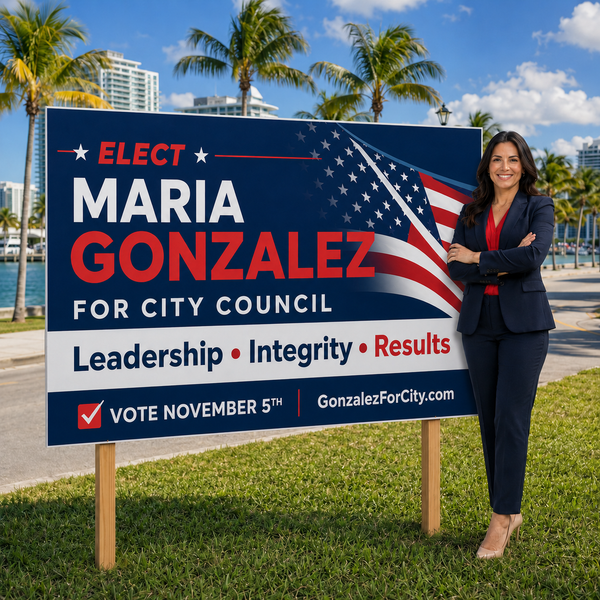
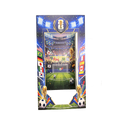
The storefront sign is the highest-impression location in any retail environment — seen by every person who passes the location, whether or not they enter. A well-designed window vinyl, a hanging banner in the window frame, or a mounted acrylic sign above the entrance communicates the brand identity and the current offer to the maximum possible audience before a single step is taken through the door. For retailers running seasonal promotions, grand opening announcements, or sale events, a storefront banner is the single highest-ROI sign placement available because it converts passing foot and vehicle traffic into store visitors. The message at the storefront must be legible in 2–3 seconds from the distance of the sidewalk or street — one primary message, large enough to read without slowing down, in a high-contrast color combination that stands out from the surrounding visual environment. Browse available options in the custom event banners collection.
Interior Brand Signs
Interior brand signs — acrylic logo walls, branded display panels, and identity signs behind the counter or register — establish the store's brand personality and communicate quality before any product is examined. A customer who walks into a store with a polished acrylic brand sign behind the counter experiences a different sense of the brand than one who walks into a store with bare walls and a printed paper sign. Interior brand signage is a one-time investment that pays dividends in every customer visit for as long as the sign is displayed. For boutique retail, salons, specialty food stores, and any retailer where the store environment is part of the brand experience, acrylic interior brand signs are among the most impactful design investments available. Browse the acrylic signs collection for available formats and sizes.
Promotional and Sale Signs
Promotional signs — "20% Off Today," "Buy 2 Get 1 Free," "New Arrival," "Limited Time Offer" — are the highest direct-response sign type in retail. They communicate an incentive that triggers immediate purchase consideration in shoppers who would otherwise browse without buying. Promotional signs work best when they are displayed at the product location (at the shelf or on the display table) rather than away from the product, so the incentive and the product are encountered simultaneously. Foam board signs on easels, acrylic table displays, and vinyl banners above product sections all serve the promotional sign function effectively at different scale and price points. Browse foam board options in the custom foam boards collection.
Wayfinding and Directional Signs
Directional signs — department labels, category markers, fitting room signs, restroom directions, and checkout indicators — reduce the friction of the shopping experience. A shopper who cannot find what they are looking for leaves without buying it. A shopper who is directed efficiently through the store finds more products, spends more time in the store, and makes more purchase decisions. Wayfinding signage is often the most underinvested sign category in independent retail — it is less exciting than promotional signage, but its cumulative effect on sales conversion is significant. Clear, consistently designed directional signs communicate that the store is well-organized and customer-focused, which is itself a positive brand signal that influences purchase confidence.
Point-of-Purchase and Counter Signs
Point-of-purchase signs at the register and checkout counter — upsell prompts, loyalty program invitations, add-on product displays, and gift card callouts — capture attention at the highest-intent moment in the shopping journey: the moment the customer has already decided to buy. A small acrylic sign next to the register communicating "Add a gift card for $25" or "Ask us about our loyalty program" converts at a significantly higher rate than the same message communicated anywhere else in the store, because the shopper is already in buying mode. Counter signs are the highest-ROI sign placement for upsell and cross-sell offers precisely because the buying decision has already been made. Browse acrylic counter sign options in the acrylic signs collection.
Product Feature and Benefit Signs
Product feature signs — callout cards, shelf talkers, and display cards that communicate key product benefits, ingredients, certifications, or differentiators — do the selling work that a self-service retail floor cannot leave to staff. A customer standing in front of two similar products at comparable price points will choose the one they understand better. A sign that communicates "cold-pressed, single origin, small batch roasted" next to a premium coffee product tells the customer exactly why it is worth the price premium over the commodity alternative beside it. Product feature signs are particularly important in specialty, artisan, and natural product retail, where the story behind the product is often the primary purchase driver and the packaging alone does not have enough real estate to communicate it fully.
Retail Sign Types Compared
Different sign materials and formats serve different retail functions, with distinct trade-offs in cost, durability, visual quality, and flexibility. This comparison maps the most common retail sign formats to their best applications.
| Sign Type | Best Retail Application | Visual Quality | Durability | Cost Range |
|---|---|---|---|---|
| Acrylic sign | Brand identity, counter displays, premium product features | Premium — glass-like finish | Excellent — years of indoor use | $30–$100+ |
| Vinyl banner | Storefront promotions, window displays, section headers | High — full color, vivid | Good — UV rated for window use | $40–$120 |
| Foam board sign | Promotional callouts, easel displays, seasonal campaigns | High — full color, sharp | Moderate — indoor only | $15–$60 |
| Retractable banner stand | Entrance displays, fitting room areas, event callouts | High — full color | Excellent — reusable, protected storage | $80–$200 |
| UV DTF product labels | Product decoration, shelf-edge stickers, price callouts | Premium — thick gloss UV finish | Very good — cured resin surface | $1–$5 per unit |
| Yard sign (A-frame) | Sidewalk promotions, entrance directionals, event traffic | Good — weather-resistant | Good — outdoor rated | $20–$50 |
| Custom magnet | Counter displays, small product callouts, loyalty offers | Good — full color | Good — moisture-resistant surface | $2–$6 per unit |
Acrylic Signs: The Premium Retail Display Investment
Among all retail sign formats, acrylic stands out as the option that communicates brand quality most effectively at close range. The polished edge, the glass-like clarity, and the depth of a reverse-printed acrylic panel create a visual impression that vinyl and paper cannot approach — and in the retail environments where customers are making purchasing decisions partly based on how the store makes them feel, that impression directly influences revenue.
- Behind-counter brand wall: A large acrylic sign with the brand name and logo behind the register or service counter communicates brand investment to every customer who approaches the checkout — the most consistent in-store audience of any display location
- Product feature callout signs: Small acrylic signs on product display tables communicate key features and differentiators with a premium finish that matches the quality message of the sign's content — a premium product deserves premium signage
- Loyalty and gift card signs: A small acrylic sign at the register for loyalty program sign-ups and gift card offers communicates permanence and importance — unlike a paper card or printed sheet, an acrylic sign signals that this offer is a standing feature of the business, not a temporary campaign
- Award and credential displays: Acrylic plaques displaying industry certifications, awards, local recognition, and media mentions build purchase confidence — customers buy more readily from businesses they can verify as credible, and an acrylic credential display communicates credibility far more powerfully than a printed certificate in a frame
- Social proof and review callouts: An acrylic sign displaying a strong customer review, a press quote, or a social media following milestone communicates social proof at the point of purchase decision — "As seen in Miami New Times" or "Rated 5 Stars by 500+ customers" next to the product being considered is a last-moment purchase confidence builder
Designing Retail Display Signs That Actually Sell
The most common failure in retail signage is not the sign itself — it is the design on it. A well-made sign with a poor design fails to capture attention, fails to communicate the offer, and fails to drive the behavior it was placed to drive. These design principles apply across every retail sign format.
One Message Per Sign
Every retail sign must have a single, primary message — one offer, one product, one call to action. Signs that try to communicate multiple messages simultaneously communicate none of them effectively because the viewer's attention is divided. "20% Off All Candles This Weekend" is a sign. "20% Off All Candles This Weekend — Plus New Arrivals — Plus Free Giftwrapping — Ask Us About Our Loyalty Program" is not a sign; it is four signs printed on one piece of material, and none of the four messages will land. Identify the single most important thing you want the shopper to do or know at each sign location, and design the sign exclusively around that one thing. Additional messages get their own sign at a different location.
Hierarchy: Big, Medium, Small
Effective retail sign design uses three levels of visual hierarchy — a large primary element (the offer or brand name), a medium secondary element (the supporting detail or call to action), and small tertiary elements (fine print, terms, additional information). The primary element should be readable from the maximum distance at which the sign will be seen. The secondary element is readable at closer range. Tertiary elements are for customers who have already stopped and are examining the sign in detail. Designing a retail sign where all three levels of information are the same size produces a visually undifferentiated panel that the eye cannot navigate — the brain registers complexity without extracting a message, and the shopper moves on.
High Contrast and Color Discipline
Retail signs must compete with the visual complexity of the store environment — product packaging, other signage, merchandise displays, and other shoppers — for a fraction of a second of attention. High-contrast color combinations (white on black, black on white, yellow on black, white on deep blue or red) are the most attention-capturing combinations available because the human visual system is tuned to detect contrast edges. Avoid low-contrast combinations — light text on a medium background, saturated text on a saturated background of a different hue — that require the viewer to work to read the sign. Keep the color palette to two or three colors maximum; additional colors dilute the contrast and the visual focus of the sign.
Typography That Works at Distance
For storefront and interior section signs that need to be read from across the store or the street, use bold, clean sans-serif typefaces with generous letter spacing. Decorative and script typefaces reduce legibility at distance and under the viewing conditions of a busy retail environment. Reserve script and serif typography for close-range signs — counter cards, product feature callouts, and point-of-purchase displays where the viewer is within arm's reach of the sign. A rough practical rule: the primary text on any retail sign should be large enough to read comfortably from twice the distance at which you expect most shoppers to encounter it. Signs that feel almost too large in isolation consistently read better in the actual store environment than signs that feel appropriately sized at the design stage.
Placement Is Part of the Design
A well-designed sign placed in the wrong location fails as surely as a poorly designed sign. Promotional signs belong at the product location — not across the store or in a general promotional area disconnected from the products being promoted. Directional signs belong at the decision points where shoppers choose which way to go, not after they have already passed the turn. Counter signs belong at eye level within the natural sightline of a customer standing at the register, not at floor level or above head height. Consider the sign placement as a core part of the design brief, not an afterthought after the sign is produced. The most effective retail signage programs design the placement strategy first and the sign format and dimensions second.
Seasonal and Promotional Sign Strategy for Retail
A static retail sign environment — the same signs in the same locations year-round — stops generating attention after the first few weeks. Customers adapt to the visual landscape of familiar environments, and signs they have seen dozens of times no longer register as new information. A rotating sign strategy that updates the in-store visual environment seasonally and promotionally maintains the attention-capturing function that static signage loses over time.
- Permanent layer: Acrylic brand identity signs, credential displays, and wayfinding signs — high-quality, long-term investments that define the store environment and change rarely if ever
- Seasonal layer: Foam board and banner signs that rotate with the season and major promotional periods — holiday sale, summer promotion, back to school, Valentine's — updated every 6–8 weeks to maintain visual freshness and communication relevance
- Campaign layer: Short-run promotional signs for specific product launches, flash sales, limited editions, and event-driven promotions — these change most frequently and benefit from the cost-effectiveness of foam board and vinyl formats that don't require the production investment of permanent signage
- Product-level layer: UV DTF labels, shelf talkers, and small product callout signs that travel with specific SKUs through the product display lifecycle — updated when products are changed, repriced, or featured in promotions; browse options in the UV DTF stickers collection
Order seasonal and promotional signs 2–3 weeks before the promotion or season they support. For Q4 holiday retail signage — the highest-impact promotional window of the year — order in early to mid-October to avoid the production delays that compress vendor timelines in November. A holiday sale sign that arrives after Thanksgiving is not a holiday sale sign. Browse the custom event banners collection and the custom foam boards collection to plan your seasonal sign program.
UV DTF Labels and Stickers for Retail Product Display
UV DTF stickers serve a distinct and highly practical role in retail display beyond large-format signage. Applied directly to product packaging, display surfaces, shelf edges, and product containers, UV DTF stickers bring the brand's visual identity and promotional messaging to the product level — the closest possible proximity to the purchase decision.
Product Packaging Decoration
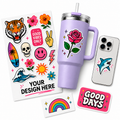
A UV DTF sticker applied to a product jar, bottle, candle, or container transforms a generic blank into a branded retail product without the minimum order requirements of custom manufactured packaging. For small-batch producers, artisan makers, and independent retailers selling private label products, UV DTF stickers are the practical path to professional-quality branded packaging at any production volume. The thick UV gloss finish looks and feels premium on retail shelves in a way that paper labels and standard vinyl do not — which translates directly to purchase confidence at the shelf. Browse the UV DTF stickers collection or build a custom layout with the UV DTF gang sheet builder.
Promotional and Sale Callout Stickers
A UV DTF sticker applied directly to a product — "New Arrival," "Staff Favorite," "Limited Edition," "20% Off This Weekend" — communicates a promotional message at the precise location of the purchase decision without requiring a separate sign format. These product-level callout stickers are particularly effective for directing shopper attention within a category display where multiple competing products are presented simultaneously. A clearly marked "Staff Pick" or "Best Seller" sticker on one item in a row of similar items draws the eye and anchors the purchase decision around that specific SKU. Order through the UV DTF gang sheet builder to produce multiple sticker designs efficiently on a single sheet.
Frequently Asked Questions
The retail signs with the most direct impact on sales are promotional and sale signs at the product location, point-of-purchase upsell signs at the register, and storefront signs that convert passing traffic into store visitors. Promotional signs at the product location trigger purchase consideration in shoppers who would otherwise browse without buying — the combination of the incentive and the product in the same visual field is the most direct conversion mechanism in retail signage. Point-of-purchase signs at the register capture the highest-intent audience in the store at the moment they are already in buying mode. Storefront banners and window signs have the highest raw impression count of any sign placement because they reach everyone who passes the location, not just shoppers who have already entered.
The best material depends on the sign's purpose and location. Acrylic is the premium choice for brand identity signs, counter displays, product feature callouts, and any sign at close-range viewing distance where material quality communicates brand quality — browse the acrylic signs collection. Vinyl banners are the best choice for storefront and window promotional signs — large format, full color, and durable for window and indoor use. Foam board is the most cost-effective material for promotional callout signs, easel displays, and seasonal campaign signage that changes frequently. UV DTF stickers serve the product level — on packaging, shelf edges, and product surfaces — at a cost per unit that makes broad product-level deployment practical. A complete retail sign program uses all four materials strategically, each in the location where it performs best.
Acrylic signs increase retail sales primarily by elevating brand perception — which directly influences purchase confidence and price tolerance. A shopper who perceives a store as premium, professional, and quality-oriented is more likely to complete a purchase, more likely to buy at full price rather than waiting for a discount, and more likely to trade up to a higher-margin product. Acrylic brand signs behind the counter, product feature displays on the sales floor, and credential or award displays throughout the store all contribute to this perception. At the counter specifically, a well-designed acrylic sign communicating a loyalty program, a gift card offer, or an upsell prompt converts at a high rate because the sign format signals that the offer is a permanent feature worth taking seriously. Browse the acrylic signs collection.
Design every retail promotional sign around a single primary message — one offer, one product, one call to action. Use a three-level visual hierarchy: a large primary element (the offer) that is readable from the maximum viewing distance, a medium secondary element (the supporting detail), and small tertiary text (fine print). Use high-contrast color combinations — white on black, black on yellow, white on deep red — that stand out from the store's visual background. Keep the typography bold and clean for the primary element; decorative and script fonts reduce legibility at the distances retail signs are read. Place the sign at the product location rather than away from the product. And design for the viewing distance: text that looks correct at the design stage frequently needs to be significantly larger to work in the actual store environment.
Place signs at the five highest-impact locations in the retail environment: the storefront exterior (captures passing traffic before entry), the entrance and store perimeter (establishes brand identity and current promotions for every incoming shopper), the product display location (pairs the promotional message with the product at the decision point), the register and counter (captures upsell and loyalty program converts at the highest-intent moment), and decision points in the store path (directional signs at forks, aisle ends, and category boundaries where shoppers choose where to go next). Promotional signs belong at the product, not in a general promotional area detached from the products being promoted. Directional signs belong at the moment of decision, not after the decision point has passed.
Use a three-layer signage strategy: permanent signs (acrylic brand identity, credentials, wayfinding) that rarely change; seasonal signs (foam board and banner promotions) that rotate every 6–8 weeks with the season and major promotional periods; and campaign signs (product launches, flash sales, limited editions) that change as often as the promotions they support. Regular customers adapt to the visual environment of a familiar store and stop registering static signs after the first few weeks — a rotating seasonal and campaign layer maintains the attention-capturing function that permanent signage loses over time. The cost of updating foam board and banner promotional signage every 6–8 weeks is a fraction of the revenue impact of keeping a fresh, attention-generating sign environment on the sales floor.
Yes — UV DTF stickers are one of the most effective and practical tools for product-level retail signage. Applied directly to product containers, packaging, and display surfaces, they communicate promotional messages ("New Arrival," "Best Seller," "Staff Favorite," "Limited Edition") at the exact point of the purchase decision. The thick UV gloss finish looks premium on retail shelving and distinguishes the labeled product visually from adjacent unlabeled products — which is precisely the shelf-level differentiation that drives category purchase decisions. UV DTF stickers also serve as professional branded packaging for small-batch and artisan products, transforming generic containers into retail-ready branded products without minimum order quantities. Build your product-level sticker layout with the UV DTF gang sheet builder or browse the UV DTF stickers collection.
The right storefront banner size depends on the available display space and the viewing distance. For most retail storefronts in strip malls, street-level retail corridors, and shopping centers, a 2x6 foot or 3x6 foot horizontal banner fits the standard window or facade space and provides enough surface area for a clear, legible message from sidewalk and street-level distance. For larger storefronts or destination retailers with higher-speed vehicle traffic, 4x8 foot and larger banners provide the visual scale needed to be legible from greater distances. The primary text on a storefront banner should be sized at a minimum of 1 inch of letter height per 10 feet of viewing distance — a banner meant to be read from 50 feet away needs primary text at least 5 inches tall. Browse available sizes and formats in the custom event banners collection.