











What Is a T-Shirt Business and Is It Worth Starting in 2026?
A t-shirt business is a custom apparel operation where you design, produce, and sell printed or decorated garments — either made to order, in bulk, or on demand. The barrier to entry has never been lower. Print-on-demand platforms, accessible decoration equipment, and direct-to-consumer selling channels have made it possible to launch a legitimate t-shirt business with minimal upfront investment and no warehouse full of inventory.
What makes 2026 a particularly good time to start: decoration technology has matured significantly. DTF transfers have eliminated the high setup costs and minimums that used to make small-run custom apparel impractical. UV DTF has opened up drinkware and hard goods as adjacent revenue streams. And the market for personalized, niche-specific apparel continues to grow — consumers increasingly want clothing that reflects specific communities, interests, and identities that mass-market brands don't serve.
The opportunity is real. So is the competition. A t-shirt business that survives past its first year is one built on a clear niche, reliable production quality, and smart use of available tools — not just a Canva design and a hope that sales will follow.
The t-shirt business fails most often not because the designs are bad, but because the operator has no defined audience, no repeatable production process, and no plan for customer acquisition beyond posting on Instagram and hoping for the best. This guide addresses all three.
Step 1: Choose Your Business Model
Before buying equipment or designing your first shirt, you need to decide how your business will actually operate. There are three primary models, each with different capital requirements, margin structures, and operational demands.
Print-on-Demand (POD)
You design the products; a third-party fulfillment partner prints and ships each order as it comes in. No inventory, no equipment, no upfront production costs. Platforms like Printful, Printify, and Gelato integrate directly with Shopify, Etsy, and other storefronts. Margins are the lowest of the three models — typically 20–35% after platform and production fees — but the risk is minimal. POD is the right starting point if you want to validate designs and build an audience before investing in equipment or inventory.
Decorated Apparel (In-House Production)
You purchase blank garments and decoration equipment, produce finished products yourself, and sell through your own channels. Equipment options include DTF transfer printers, heat presses, screen printing setups, and embroidery machines. Margins are the highest of the three models — 50–70% is achievable once you're efficient — but upfront equipment investment ranges from $500 (entry-level heat press and outsourced DTF transfers) to $30,000+ (in-house DTF printer and curing unit). This model suits operators who want full control of quality and turnaround.
Hybrid Model
You handle some decoration in-house and outsource the rest. A common hybrid approach: maintain a heat press for local rush orders and small custom jobs, outsource DTF transfers for full-color complex designs, and use POD for passive income from evergreen designs in your online store. The hybrid model gives you flexibility — you can take custom local orders, fulfill your online store passively, and scale the in-house side as volume grows without overinvesting before you have consistent demand.
Step 2: Find Your Niche
The biggest mistake new t-shirt businesses make is trying to sell to everyone. "Everyone who wears t-shirts" is not a target market. A defined niche gives you a specific audience to speak to, a focused design direction, and a reason for customers to choose your brand over the hundreds of generic options available on every marketplace.
A good niche has three characteristics: a passionate and identifiable community, underserved by existing options, and large enough to generate sustainable revenue. You do not need a massive niche — a focused brand serving 50,000 people extremely well will outperform a generic brand trying to reach 5 million people with nothing distinctive to say.
- Profession-based niches: Teachers, nurses, electricians, firefighters, welders, veterinarians — people who identify strongly with their work and buy apparel that reflects it
- Hobby and interest niches: Fishing, hunting, hiking, CrossFit, van life, homesteading, disc golf, amateur radio — communities with strong identity markers and existing merchandise culture
- Local and regional niches: City-specific pride apparel, local sports team fan gear, regional culture — easier to build community around, strong word-of-mouth potential
- Event and custom order niches: Family reunions, school events, sports teams, corporate groups — recurring demand, referral-driven, relationship-based sales cycle
- Cause and community niches: Mental health awareness, sobriety communities, veteran support, breed-specific pet owners — buyers with strong emotional connection to the identity the apparel represents
The best niche is usually one you already belong to. You understand the inside language, the specific references that land, and what the community actually wants to wear — versus what an outsider thinks they want.
Step 3: Choose Your Decoration Method
Your decoration method determines your production costs, design flexibility, minimum order requirements, and the quality of your finished product. Each method has a different profile — the right choice depends on your business model, budget, and niche.
| Method | Upfront Cost | Per-Unit Cost | Full Color | Min. Order | Best For |
|---|---|---|---|---|---|
| DTF Transfers (outsourced) | Low — heat press only | Low–medium | Yes | 1 unit | Small batch, full color, fast turnaround |
| Screen Printing | High — screens and press | Low at volume | Limited colors | 24–50 units per design | High-volume, simple designs |
| Direct-to-Garment (DTG) | Very high — $15,000+ | Medium | Yes | 1 unit | On-demand full color, no transfer step |
| Heat Transfer Vinyl (HTV) | Low — cutter and press | Low | Limited — solid colors only | 1 unit | Simple text and solid-color designs |
| Embroidery | High — embroidery machine | Medium | Thread colors only | 1 unit | Premium, structured garments and hats |
| Print-on-Demand (POD) | Zero | High | Yes | 1 unit | Passive income, design validation, zero inventory |
| Sublimation | Medium — printer and press | Low | Yes | 1 unit | All-over print, polyester only |
For most new t-shirt businesses starting in 2026, outsourced DTF transfers with a heat press is the lowest-risk entry point. You buy transfers printed to your design from a DTF supplier, press them onto blanks yourself, and sell the finished product. No large equipment investment, no minimum order requirements, full-color capability, and production quality that rivals in-house DTG printing at a fraction of the equipment cost.
Step 4: Source Your Blank Garments
The blank garment is half of the finished product. Decoration quality means nothing if the shirt itself shrinks after two washes, pills within a month, or fits poorly. Your blank choice directly affects customer satisfaction, return rates, and whether buyers order again.
Wholesale Blank Distributors
S&S Activewear, SanMar, and Alpha Broder are the three largest wholesale blank distributors in the US. They carry virtually every major blank brand — Bella+Canvas, Next Level, Gildan, Comfort Colors, Port & Company — at wholesale pricing with no minimums on most styles. You'll need a business license or resale certificate to open a wholesale account. Wholesale pricing is typically 40–60% below retail, which is essential for maintaining healthy margins.
Retail Sources for Small Batches
When starting out or testing a new design, buying blanks from retail sources — Michaels, JoAnn, or Amazon — is acceptable for very small quantities. Retail pricing kills your margins at scale, but it lets you test a new product category or design without committing to wholesale case quantities. Transition to wholesale accounts as soon as your order volume justifies it.
Blank Selection by Niche
Match your blank quality to your price point and audience. Gildan Heavy Cotton is the right choice for low-cost event shirts and large group orders where price per unit matters most. Bella+Canvas 3001 and Next Level 3600 are the industry-standard premium blanks for lifestyle and fashion-forward brands where the customer is paying for the quality of the shirt itself. Comfort Colors 1717 suits vintage-aesthetic and southern/coastal lifestyle brands. Do not use the cheapest possible blank for a premium-priced product — it will show.
Step 5: Set Up Your Selling Channels
Where you sell determines who finds you, how much platform fees eat into your margins, and how much control you have over your brand presentation and customer relationships. Most successful t-shirt businesses use multiple channels simultaneously.
Your Own Online Store (Shopify or Similar)
A Shopify store is your highest-margin, highest-control channel. You own the customer relationship, the email list, and the brand presentation. Transaction fees are low (0.5–2% depending on plan), and you can build a brand experience that marketplaces don't allow. The tradeoff is that you must drive your own traffic — Shopify doesn't send customers to you the way Etsy or Amazon does. Build this channel from day one, even if it's not your primary revenue source initially.
Etsy
Etsy has a large built-in audience actively searching for custom and personalized apparel. For businesses selling custom event shirts, personalized tumblers, and niche designs, Etsy's search traffic is a genuine customer acquisition channel. The tradeoffs: Etsy takes listing fees, transaction fees (6.5%), and payment processing fees on every sale, and the platform can change its algorithm or policies in ways that affect your visibility. Use it as a traffic source while building your own store in parallel.
Local and In-Person Sales
Farmers markets, craft fairs, pop-up events, and local vendor markets provide immediate cash sales, direct customer feedback, and zero shipping logistics. For businesses in the custom and event apparel space, local visibility also drives word-of-mouth referrals for group orders — a single school or sports organization order can be worth hundreds or thousands of dollars and generate repeat business for years. Do not underestimate local as a channel.
Social Media and Direct Sales
Instagram, TikTok, and Facebook groups are viable direct sales channels for small apparel businesses, particularly for niche communities. A single viral TikTok video showing your production process or a compelling design can generate hundreds of orders. Social selling requires consistent content output, but for businesses with a strong visual product and a defined community, it can be the highest-ROI acquisition channel available.
Step 6: Price Your Products Correctly
Underpricing is the most common financial mistake in the t-shirt business. New operators set prices based on what they think customers will accept rather than what the business requires to be sustainable. A t-shirt priced at $15 that costs $12 to produce and $4 to ship is a loss leader, not a product.
| Cost Component | Example (Basic Custom Tee) | Notes |
|---|---|---|
| Blank garment | $4.00–$8.00 | Varies by brand and quality tier |
| DTF transfer (outsourced) | $2.00–$4.00 | Depends on size and supplier |
| Labor (pressing, packaging) | $1.50–$3.00 | Include your time at a real hourly rate |
| Packaging materials | $0.50–$1.50 | Poly mailer, tissue, hang tag |
| Shipping | $4.00–$6.00 | First class or ground advantage |
| Platform / transaction fees | $1.00–$3.00 | Etsy, Shopify, PayPal cuts |
| Total landed cost | $13.00–$25.50 | Before any profit |
| Recommended retail price | $28.00–$38.00 | 2–3x cost for healthy margin |
A 2–3x markup on total landed cost (not just blank cost) is the minimum viable pricing for a sustainable t-shirt business. If your market won't support that markup, either your costs are too high or your niche isn't viable at your price point. Do not solve a pricing problem by accepting lower margins.
Step 7: Build a Brand, Not Just Designs
A t-shirt business with strong designs but no brand identity is competing on design alone — and there are millions of designs available. A brand gives customers a reason to return, to recommend, and to pay more than they would for a generic equivalent. Brand identity in the t-shirt business means a consistent visual style, a defined voice, a clear point of view about who the customer is, and packaging and presentation that reinforces all of the above.
- Name and logo: Choose a name that is easy to spell, easy to remember, and available as a domain and social handle — check trademark availability before committing
- Consistent visual style: Pick 2–3 fonts and a limited color palette and apply them consistently across your store, packaging, and social content — visual consistency signals professionalism
- Photography: Flat lays and lifestyle photos on real people consistently outperform mockup-only product listings — invest in decent product photography early
- Packaging: A poly mailer with your logo, a tissue-wrapped shirt, and a simple thank-you card costs under $1 extra and dramatically improves the unboxing experience — which drives reviews and repeat purchases
- Hang tags: A simple hang tag with your logo, care instructions, and social handle adds a finished, retail-quality feel that most small apparel businesses skip
Step 8: Set Up Your Business Legally
Operating as a legitimate business from the start protects you personally, enables wholesale accounts, allows you to collect and remit sales tax properly, and makes it easier to get paid by larger clients and organizations. None of this is complicated, but skipping it creates problems later.
Register Your Business Entity
Form an LLC (Limited Liability Company) in your state. An LLC separates your personal assets from business liabilities, costs $50–$500 depending on the state, and takes less than a week to process in most states. A sole proprietorship is simpler but offers no liability protection. For a business that decorates physical goods and sells to the public, an LLC is worth the registration cost.
Get an EIN and Open a Business Bank Account
An Employer Identification Number (EIN) is free from the IRS and takes about 5 minutes to obtain online. You need it to open a business bank account, apply for wholesale accounts, and file business taxes. Keep business and personal finances completely separate from day one — commingled finances are the most common cause of LLC liability protection being voided and make tax time exponentially more difficult.
Get a Resale Certificate
A resale certificate (also called a seller's permit or resale license) allows you to purchase blank garments wholesale without paying sales tax — because you'll collect sales tax when you sell the finished product to the end customer. Requirements vary by state but most are free or low cost to obtain through your state's department of revenue. Without this, wholesale distributors like SanMar and S&S may not open an account for you, and you'll pay unnecessary sales tax on every blank you buy.
Step 9: Scale — When and How
Scaling before you have consistent, repeatable demand is how t-shirt businesses end up with $10,000 of equipment they use twice a week. Scale in response to demonstrated demand, not in anticipation of it.
Bring Production In-House When Volume Justifies It
If you're outsourcing DTF transfers and pressing 50+ shirts per week consistently, the math on in-house DTF printing starts to work. A commercial DTF printer and curing unit costs $5,000–$15,000 new and brings your per-transfer cost from $2–4 down to $0.50–1.00 at volume. Run the numbers at your actual current volume before investing — not at the volume you hope to reach in six months.
Add Adjacent Product Categories
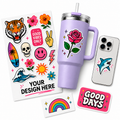
Once your apparel business has a customer base, adding complementary products increases average order value without requiring new customer acquisition. Custom drinkware, hats, tote bags, and hard goods like custom tumblers and UV DTF stickers are natural extensions of a decorated apparel business. Customers who buy a custom shirt for an event will often buy matching drinkware if it's available and easy to order.
Build Recurring Revenue Through B2B Accounts
One-off consumer orders are the hardest revenue to grow. B2B accounts — schools, sports leagues, churches, local businesses, restaurants — place recurring orders on a predictable schedule and refer other organizations. A single school account placing 4 orders per year at $500 each is worth more to your business than 80 random Etsy sales. Pursue B2B relationships deliberately once your production capacity and reliability can support them.
Frequently Asked Questions
You can start a print-on-demand t-shirt business for under $100 — a Shopify or Etsy account, a POD platform integration, and basic design tools. A decorated apparel business using outsourced DTF transfers and a heat press requires $300–$800 for an entry-level heat press, plus your first blank and transfer order. An in-house DTF printing setup starts at $5,000–$8,000 for entry-level commercial equipment. Most people starting in 2026 should begin with outsourced transfers and a heat press, then invest in in-house equipment once volume justifies it.
For most new t-shirt businesses in 2026, outsourced DTF transfers with a heat press is the best starting point. It requires minimal upfront investment, supports full-color complex designs with no minimums, works on cotton, polyester, and blends, and produces professional results. As volume grows, bringing DTF printing in-house becomes cost-effective. Screen printing offers better per-unit economics at high volumes but requires significant setup investment and minimum order quantities that don't suit small-batch or custom operations.
Requirements vary by state and municipality, but in most cases you need to register your business entity (LLC or sole proprietorship), obtain a resale certificate to buy blanks wholesale without paying sales tax, and register to collect and remit sales tax in states where you have nexus. A general business license may also be required by your city or county. Operating without these in place creates legal and tax exposure — get the paperwork done before you start generating meaningful revenue.
A well-run decorated apparel business producing in-house can achieve 50–65% gross margins. After overhead (equipment, software, platform fees, packaging, shipping supplies), net margins of 20–35% are realistic for an established small operation. Print-on-demand businesses run gross margins of 20–35% with minimal overhead. The most profitable t-shirt businesses combine B2B group order revenue (which has predictable demand and lower customer acquisition cost) with direct-to-consumer online sales. Profitability depends far more on niche selection, pricing discipline, and customer acquisition strategy than on decoration method.
Yes — a heat press and blank inventory fit easily in a spare room or garage, and most small decorated apparel businesses operate from home in their early stages. Check your local zoning regulations, HOA rules if applicable, and homeowner's or renter's insurance policy to ensure a home-based business is permitted and covered. As volume grows and you need more storage, production space, or employees, transitioning to a commercial space makes sense — but home-based operation is entirely viable up to several hundred shirts per week with the right setup.
Your first customers almost always come from your existing network and community. Tell people what you're doing, show your work on social media, offer to produce shirts for a local organization at cost in exchange for referrals and a photo, and list on Etsy where buyers are already searching for custom apparel. Selling to local groups, sports teams, and event organizers is often faster and more reliable than building organic online traffic from scratch. One good group order referral can sustain a new business for months while you build other channels.
DTF (Direct-to-Film) transfers support full-color, photographic, and complex designs with no minimums and fast setup — you can print one shirt as economically as ten. Screen printing requires a screen to be made for each color in the design, which makes it cost-effective only at quantities of 24 or more identical shirts. Screen printing has a more traditional, slightly textured print feel that some markets prefer, and per-unit costs drop significantly at high volumes. For a new business handling small custom orders and varied designs, DTF is almost always more practical. Screen printing becomes relevant when you're running large batches of simple, consistent designs.
Basic design skills help, but they are not a hard requirement. Tools like Adobe Illustrator, Canva Pro, and Kittl make it possible to produce print-ready designs without formal design training. For complex original artwork, many small apparel businesses outsource design to freelancers on Fiverr or 99designs and focus their own time on production, sales, and operations. What matters more than design skill is understanding what your niche audience wants to wear — that market insight is harder to outsource than the execution of the artwork itself.


