









What grand opening signage actually does for a new business
A business can open its doors without any signage at all. The lights are on, the door is unlocked, the staff is ready — and almost nobody comes. Not because the business is bad, but because nobody knew it was there. Grand opening signage solves that problem. It is the physical announcement to everyone who passes the location that something new has arrived, it is open, and they should come in.
The window between a business opening and the moment it builds enough word-of-mouth to sustain itself is the most critical and most fragile period in its life. The customers who come in during the first two weeks become regulars. Regulars become the people who tell their friends and colleagues. The brand awareness and early customer relationships built in those first weeks have an outsized influence on whether the business finds its footing or struggles to build momentum. Signage that maximizes visibility during that window pays back far more than its cost.
Grand opening signage also does something subtler — it signals neighborhood legitimacy. A new business with professional, well-designed signage communicates that it is established, serious, and worth visiting. A new business that opens without visible signage communicates uncertainty about itself. Customers pick up on both signals before they have walked through the door.
The two weeks after a grand opening are disproportionately important to the long-term success of any local business. Every dollar invested in visibility during that window generates returns that extend far beyond the opening period through the customers, regulars, and referrals it creates.
The essential grand opening sign and banner types
Storefront vinyl banner
The storefront banner is the centerpiece of any grand opening signage campaign. Mounted across the building facade, under the awning, or along the storefront exterior, a large vinyl banner announces the opening to everyone who passes the location. The standard grand opening storefront banner communicates three things: the business name, the grand opening announcement, and a reason to come in — an offer, a date, or a simple invitation. At 3' × 8' or larger, a well-placed storefront banner is visible from a full block away in either direction and creates immediate visual presence in the commercial corridor the moment it goes up.
Yard signs for neighborhood radius coverage
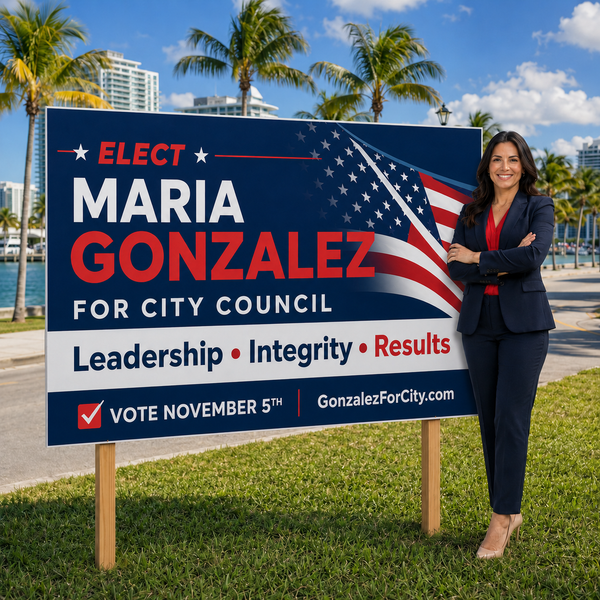
A yard sign campaign deployed at intersections within two to three blocks of the new location extends grand opening visibility to the neighborhood that represents the most valuable early customer pool. The people who live and work within walking or short driving distance of a new business are its most likely regulars — and reaching them before they have established habits elsewhere is one of the highest-value marketing activities a new business can invest in. A campaign of 8 to 15 yard signs covering the key intersections in your immediate radius reaches hundreds of neighborhood residents who would not have passed your storefront banner.
Entrance foam board or A-frame sign
A foam board sign on an easel at the entrance — or an A-frame on the sidewalk — captures the attention of pedestrians who are already right in front of your location. Where the storefront banner communicates to traffic approaching from a distance, the entrance sign communicates to people at the doorstep with enough proximity to read more detail — an opening offer, hours, a welcome message, or a specific call to action. In commercial areas with heavy foot traffic, a well-positioned entrance sign converts passersby into walk-ins at the moment they are closest to the door.
Window signs and door graphics
Window clings and door graphics communicate to pedestrians walking directly alongside the building who may not look up at the overhead banner. A "Now Open" or "Grand Opening" window graphic at eye level on the storefront glass makes the opening announcement readable at foot level, reinforces the storefront banner message, and ensures the building communicates the opening from every viewing angle. Window graphics also serve an interior purpose — they make the business look open and active from inside looking out, creating the warmth and visual activity that draws passersby in.
Fence and perimeter banners
Businesses with parking lots, exterior fencing, adjacent construction barriers, or perimeter walls have additional signage real estate that multiplies grand opening visibility beyond the storefront. A vinyl banner along a parking lot fence line or mounted to a perimeter wall creates a second large-format advertising surface visible from the street or adjacent properties. For strip mall and plaza locations where the parking lot is the primary approach, fence and perimeter banners can be more visible to arriving customers than the storefront banner itself.
Interior welcome and display signs
Once customers cross the threshold, interior signage sustains the grand opening experience. A welcome foam board at the entry, promotional display signs highlighting opening offers, menu or product display signs, and directional signs in larger spaces all contribute to the first-visit impression that determines whether a customer becomes a regular. The interior signage does not need to announce "Grand Opening" — it needs to communicate that the business is organized, professional, and worth returning to.
How to design grand opening signage that drives action
Grand opening banners and signs compete for attention in commercial environments full of established businesses with existing signage. These principles consistently separate grand opening signage that generates foot traffic from signage that gets looked past.
- "Grand Opening" or "Now Open" in the largest text on the banner. This phrase earns the second look. Everything else is secondary. It needs to be readable at the maximum distance from which the banner is visible — typically a full block in each direction for a storefront on a commercial street.
- Tell passersby what you are, not just who you are. "[Business Name] — Now Open" tells half the story. "[Business Name] — Custom Print Shop — Now Open" tells the whole story. People who do not already know your business name need to know what you do before they have a reason to come in.
- Include a grand opening offer if you have one. A specific incentive — 20% off opening week, free consultation, complimentary first item — gives people a reason to act now rather than meaning to come by eventually. "Grand Opening — 20% Off All Week" outperforms "Grand Opening" every time because it gives urgency to a decision that could otherwise be deferred indefinitely.
- Maximum five elements on a storefront banner. Business name, grand opening announcement, what you do, an offer or date, and contact or website. More than five and the banner loses legibility at reading distance. Simplicity is not a compromise — it is a requirement for signage that communicates at speed and distance.
- High contrast throughout. White text on dark background or dark text on white reads clearly in direct sun, overcast, and at dusk. Color combinations that look refined in design files often lose contrast in outdoor light. Err toward stronger contrast than you think you need — it will be right when the banner is installed.
- Submit print-ready files at the correct resolution. Banner files need to be at 100–150 DPI at actual print dimensions — not scaled-up web images. A 4' × 10' banner needs a source file at 600 × 1500 pixels at 150 DPI minimum. Files submitted at 72 DPI will print with visible softness that signals low production quality to every close-range viewer.
Grand opening sign formats compared
| Format | Best placement | Indoor / Outdoor | Reusable | Best for |
|---|---|---|---|---|
| Vinyl storefront banner | Building facade, awning, fence | Both | Yes | Primary visibility from street |
| Yard sign | Neighborhood intersections | Outdoor | Yes | Radius coverage beyond storefront |
| Foam board on easel | Entrance, sidewalk, interior | Indoor only | Moderate | Close-range pedestrian messaging |
| Acrylic sign | Reception, lobby, interior walls | Indoor | Yes — very durable | Permanent interior brand presence |
| Window cling / graphic | Storefront glass, door | Indoor face, outdoor face | No | Eye-level pedestrian communication |
Grand opening signage timeline
| When | Action |
|---|---|
| 4 weeks before opening | Finalize all sign designs, submit files to Tawgraphix, confirm sizes and quantities |
| 3 weeks before opening | Receive signage, inspect all pieces, confirm mounting hardware — grommets, stakes, easels |
| 1 week before opening | Install storefront banner, check local ordinance compliance for any signage on or near public areas |
| 2–3 days before opening | Deploy neighborhood yard signs at key intersections within your radius |
| Opening day | Position entrance foam boards and A-frames, confirm all signage is secure before doors open |
| During opening period | Check and re-secure banners after wind or rain — inspect yard signs and replace any that have been disturbed |
| After opening period (2–4 weeks) | Transition grand opening banners to promotional offer signage — retrieve yard signs and store for reuse |
What to do with your signage after the grand opening period
Grand opening signage does not expire when the opening period ends — the physical materials remain useful long after the launch window closes. Planning for this from the start saves money and extends the value of the initial investment.
Transition storefront banners to ongoing promotions
A vinyl banner without "Grand Opening" language — one that leads with your business name, what you offer, and a current promotion — can serve the storefront for months or years after the opening. When designing your grand opening banner, consider whether a second version without opening-specific language would extend its useful life as an ongoing promotional display. Ordering both at the same time saves the per-unit cost of a separate reorder later.
Repurpose yard signs for seasonal campaigns
Yard signs without opening-specific dates or messaging can be retrieved from grand opening deployment and reused for future promotional campaigns, seasonal events, and local marketing initiatives. A set of 10 to 15 yard signs with your business name and offer language becomes a reusable marketing asset deployable for every future promotion — not a one-time expense for the opening period alone.
Upgrade temporary interior signs to permanent acrylic
Foam board signs used during the grand opening period as temporary interior displays can be replaced with permanent acrylic signs once the business is established and the interior layout is confirmed. The grand opening period is a useful test of where signage belongs in the space — what gets noticed, what guides customers, what communicates most effectively — before investing in permanent materials. Use the opening period to learn, then invest in permanent signage based on what you observed.
Order your grand opening signs and banners at Tawgraphix
Tawgraphix produces the full range of grand opening signage — vinyl banners, foam boards, acrylic signs, and yard signs — with full-color printing, no minimum order requirements, and shipping across the USA with tracking on every order.
Submit your design files
Upload your grand opening banner, yard sign, and any interior sign artwork. Vector files — SVG, AI, PDF with fonts outlined — produce the sharpest output for text-heavy signs. PNG files with transparent backgrounds at 100–150 DPI at actual print dimensions work well for designs with logos and complex artwork. Submit all files at the correct dimensions for your intended sign sizes before ordering.
Select your formats and quantities
Order your storefront vinyl banner in the size that fills your facade space. Add yard signs in the quantity needed for your neighborhood radius — typically 8 to 15 for most storefront locations. Include foam boards for entrance and interior display. No minimum order requirement means you can order exactly what your opening campaign requires without overstocking.
Order early — give yourself the lead time your opening deserves
Order at least three to four weeks before your opening date to allow for production, shipping, and setup before your doors open. Grand openings have fixed, immovable dates — do not compress your lead time and risk arriving at opening day without your signage in place. Every day the sign is not up before the opening is a day of visibility your business did not generate.
Order vinyl banners at the Tawgraphix event banners collection, foam boards at the Tawgraphix foam boards collection, acrylic signs at the Tawgraphix acrylic signs collection, and yard signs at the Tawgraphix custom yard sign page.
Frequently asked questions about grand opening signs and banners
Order at least three to four weeks before your opening date. This provides buffer for production, shipping, and setup before the opening day — plus time to identify and address any issues before they become a problem on a fixed date. Businesses that order signage a week before their opening frequently encounter delays that leave them opening without the visibility they planned for. Build in the lead time your opening deserves.
Match the banner width to the available mounting space on your storefront. For most commercial storefronts, a 3' × 8' or 4' × 10' banner provides strong visibility. Wider storefronts can accommodate larger banners — 4' × 16' or 4' × 20' — that fill the facade more completely and read from further away. The goal is to fill the available facade space proportionally. A banner that looks undersized on a large building loses visual impact at the distance from which it needs to communicate.
Two to four weeks is the standard grand opening period for most businesses. Beyond four weeks, "grand opening" messaging loses urgency and can make the business look like it forgot to take its banners down rather than a thriving new location. After the opening period, transition to a promotional banner or permanent signage. For businesses that had a soft opening before a formal grand opening event, the banner period typically runs from the formal event date rather than the initial opening date.
Temporary signage permit requirements vary by municipality. Banners mounted to your own leased or owned building frontage are typically permissible under most local commercial signage codes, though size limits and display duration rules vary. Signs placed in or near public right-of-ways — road medians, sidewalk strips, public land — are more restricted in most jurisdictions. Check with your local city or county planning or zoning office before installing any signage that extends beyond your property boundary.
Vinyl banners without "Grand Opening" specific language are reusable for future promotional campaigns indefinitely. When designing your grand opening signage, consider ordering a second version of your storefront banner without the opening-specific headline — one that leads with your business name and a generic promotional offer — so you have a reusable ongoing promotional display ready the moment the opening period ends. Store vinyl banners rolled rather than folded between uses to prevent permanent crease lines.
The storefront banner — mounted and visible before the doors open on day one. It is the primary signal to the street that a new business is open for business. If only one piece of signage is ready on opening day, make it the storefront banner. Everything else — yard signs, entrance signs, interior displays — amplifies the storefront banner's message and extends its reach, but the storefront banner is the foundation that everything else builds on.