











Vinyl stickers and UV DTF stickers can look nearly identical in a product photo, and it's easy to assume they're the same product with a different name. They're not — the materials, durability, and best-use cases genuinely differ, and picking the wrong one for your application means either overpaying for durability you don't need or underbuying for a use case that needed more.
What Vinyl Stickers Are
A standard vinyl sticker is printed on adhesive-backed vinyl film, typically with a separate laminate layer applied over the print for UV and scratch protection. The laminate is what gives a quality vinyl sticker its water and fade resistance — without it, a printed vinyl sticker fades and scratches much faster.
What UV DTF Stickers Are
UV DTF stickers are printed with UV-cured ink that cures instantly under UV light during production, creating a durable, glossy, textured surface as part of the print itself rather than as a separate laminate step. This built-in durability is why UV DTF stickers tend to have a more dimensional, slightly raised feel compared to the flatter surface of a laminated vinyl sticker.
Key Differences
- Surface feel: UV DTF has a raised, glossy, tactile quality; vinyl (even laminated) stays flatter and smoother to the touch
- Durability without lamination: UV DTF gets its water/scratch resistance built into the ink cure itself; a non-laminated vinyl sticker is noticeably less durable than either UV DTF or laminated vinyl
- Surface application range: UV DTF adheres well to a wide range of hard surfaces (tumblers, hard phone cases, laptops, glass) with strong adhesion out of the gate; vinyl's performance varies more by surface and adhesive grade
- Removability: vinyl stickers, particularly on window/removable-grade adhesive, are generally easier to remove cleanly if that's a requirement; UV DTF's stronger bond makes it better suited for permanent or long-term placement rather than temporary application
When Vinyl Makes More Sense
- Large-format applications like window clings or vehicle graphics, where vinyl's flexibility and established large-format printing infrastructure is the standard
- Temporary or removable placements where you want the sticker to come off cleanly later
- Very simple, high-volume single-color runs where vinyl's cost structure at scale can come in lower
When UV DTF Makes More Sense
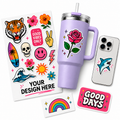
- Small, detailed, full-color designs on hard surfaces — tumblers, hard phone cases, laptops — where the raised texture and built-in durability show best
- Anything that needs strong water and scratch resistance without a separate lamination step
- Permanent or long-term placements where you're not planning to remove it later
The Practical Takeaway
Neither is universally "better" — they're built for different jobs. If you're decorating small, detailed, hard-surface items and want strong built-in durability without extra production steps, UV DTF is the closer match. If you're working large-format, need removability, or are printing very high volume of simple designs, standard vinyl is often the more practical and economical choice.
Frequently Asked Questions
Is UV DTF more durable than vinyl stickers?
UV DTF's UV-cured ink builds durability into the print itself, comparable to a well-laminated vinyl sticker, and more durable than a non-laminated vinyl print.
Can UV DTF stickers be removed cleanly like vinyl?
Generally no — UV DTF's stronger bond makes it better suited for permanent placement, while vinyl (particularly removable-grade adhesive) is typically easier to remove cleanly.
Which is better for small, detailed designs?
UV DTF, since its raised, textured surface and built-in durability show best on small, detailed, full-color designs applied to hard surfaces.
Compare both directly — check out UV DTF Stickers to see the finish for yourself on your own design.


