











What makes a promotional product actually work in 2026
The promotional products industry generates billions of dollars annually, and a significant portion of that spend produces merchandise that ends up in a junk drawer within two weeks. Branded pens that run out of ink. Tote bags that pile up in closets. Cheap t-shirts that shrink after one wash. Businesses write these off as the cost of doing marketing without asking the harder question — what actually makes a promotional product work?
A promotional product works when the recipient uses it. That is the only metric that matters. A product that gets used generates brand impressions continuously at zero additional cost. A product that gets discarded generated exactly one impression — the moment it was received — and then nothing. Every other consideration is downstream from that single fact.
In 2026 the promotional products that work best share three qualities: genuine daily utility, design quality that the recipient finds appealing independent of the branding, and material quality that holds up to the use case it was designed for. Products that have all three get used publicly and kept for years. Products that have none get thrown away. This guide covers the products that consistently deliver on all three for businesses in 2026.
The question to ask before ordering any promotional product: Would the person I am giving this to seek it out and buy it for themselves if it did not have my logo on it? If the answer is no, reconsider the product. If the answer is yes, you have found something worth putting your brand on.
1. Custom insulated tumblers
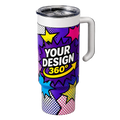
Custom insulated tumblers have become the dominant promotional product for businesses that understand how brand impressions actually accumulate. A quality double-wall stainless steel tumbler gets used multiple times every day — at home, in the car, at the office, at the gym. Over a two to three year lifespan that represents thousands of direct brand impressions for the person using it, plus dozens of secondary impressions from everyone who sees it in their hand.
The cultural moment behind the tumbler format — driven by years of viral Stanley, YETI, and Hydro Flask content — means that recipients have strong positive associations with insulated tumblers before they even open the package. A well-made branded tumbler does not feel like promotional merchandise. It feels like a premium product gift that happens to have a logo on it.
- Best for: corporate gifting, client appreciation, employee onboarding, event merchandise, loyalty rewards, and social media giveaways
- Why it works: daily use, high public visibility, strong gifting perception, full-wrap print surface for brand storytelling
- What to look for: double-wall vacuum insulation, leak-proof lid, cupholder-compatible base, full-color UV DTF printing capability
2. Custom apparel with DTF transfers
Custom branded apparel has always been a promotional staple — but the method of production has changed significantly and the change matters for quality. Direct to Film (DTF) transfers have replaced screen printing and HTV vinyl as the dominant production method for small-to-medium branded apparel runs because they eliminate minimum order requirements, support full-color photographic designs, and work on every fabric type including dark colors.
For businesses, this means branded apparel is now practical at any quantity — a startup can order five branded hoodies for its founding team with the same design quality as a company ordering five hundred. The design can be as complex as a photographic image or as simple as a logo, and the output looks identical in terms of print quality.
Apparel remains one of the highest-visibility promotional products because it turns the wearer into a mobile billboard in public spaces — offices, events, airports, gyms, and streets. A well-designed branded shirt that someone actually wants to wear is one of the most effective forms of ambient advertising a business can invest in.
- Best for: team uniforms, event staff, branded merchandise, trade show giveaways, creator merch drops
- Why it works: high public visibility, worn in diverse environments, strong social identity signal for teams and communities
- What to look for: DTF transfers that work on cotton and dark fabrics, no minimum order, full-color design support
3. Custom magnets
Custom magnets punch significantly above their weight class as promotional products. The business card magnet in particular has a retention rate that no paper alternative can match — a well-designed magnetic business card on a client's refrigerator or filing cabinet stays in daily view for years. Every time they need your service, your name and number are already visible.
Vehicle door magnets serve a completely different function — turning any company vehicle into a branded mobile advertisement that can be removed for personal use and reapplied for work. For contractors, service businesses, and mobile brands, a pair of vehicle door magnets provides ongoing neighborhood-level brand visibility at a fraction of the cost of a permanent vehicle wrap.
- Best for: service businesses, real estate agents, restaurants, contractors, trade show giveaways
- Why it works: extremely high retention rate, permanent passive visibility in homes and offices, reusable across years
- What to look for: full-color printing, strong magnetic hold, durable finish that resists scratching and fading
4. UV DTF stickers for product branding
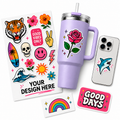
UV DTF stickers are not traditional promotional stickers — they are premium peel-and-stick transfers designed for hard surfaces like glass, metal, plastic, and acrylic. For businesses that sell or customize physical products, UV DTF stickers solve the branding problem that most small product businesses face: how to add professional full-color branding to physical goods without owning a printing facility.
A candle brand that applies a UV DTF sticker to a glass jar has a retail-ready product. A tumbler customizer who applies a UV DTF design to a stainless steel cup has a branded merchandise item. A packaging business that applies UV DTF labels to boxes has a premium unboxing experience. The promotional power here is embedded in the product itself — every person who interacts with the branded product sees the brand.
- Best for: product-based businesses, candle brands, drinkware customizers, packaging branding, retail merchandise
- Why it works: full-color professional finish on hard surfaces, no equipment needed to apply, makes products look retail-ready
- What to look for: compatibility with glass, plastic, and metal surfaces, water-resistant finish, transparent background support
5. Custom signage for physical locations and events
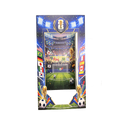
Businesses with physical locations — retail stores, offices, service locations, event spaces — have a consistent need for printed signage that communicates brand presence, guides customers, and supports promotions. Custom signage covers a wide range of formats — acrylic signs, vinyl banners, foam boards, and yard signs — each serving specific functions within a business's physical environment.
For promotional purposes specifically, signage that supports a campaign at the point of sale or in the physical location where customers make buying decisions is among the most cost-effective marketing spend available. A well-designed foam board display near the checkout communicating a promotion reaches every customer at the exact moment they are most likely to act on it.
- Best for: retail locations, offices, events, trade shows, grand openings, outdoor advertising
- Why it works: point-of-decision placement, reusable across campaigns, scales from single location to multi-location rollouts
- What to look for: material suited to indoor or outdoor placement, full-color print quality, appropriate size for viewing distance
How the top promotional products compare on the factors that matter
| Product | Daily use | Public visibility | Lifespan | Gifting perception | Best use |
|---|---|---|---|---|---|
| Custom tumbler | Very high | Very high | 3–5+ years | Premium | Gifting, corporate, events |
| Custom apparel (DTF) | Moderate | Very high when worn | 1–3 years | Moderate–high | Teams, events, merch |
| Custom magnets | Passive | Indoor / vehicle | 3–5+ years | Moderate | Service businesses, referrals |
| UV DTF stickers | Product use | On product surface | 1–3 years | High (on product) | Product branding, packaging |
| Custom signage | Passive display | Location-dependent | 1–5 years | N/A | Retail, events, offices |
| Branded pens | Low | Very low | Weeks | Very low | High-volume mass giveaway only |
| Branded tote bags | Occasional | Moderate when used | 1–2 years | Low | Conferences, retail bags |
How to build a promotional product strategy that compounds over time
Most businesses treat promotional products as one-off purchases for specific occasions. The businesses that get the most return treat them as a system — a set of products deployed intentionally across different customer touchpoints that builds brand presence cumulatively over time.
Map products to moments, not just events
The most effective promotional product deployment matches the right product to a meaningful moment in the customer or employee relationship. A tumbler at the close of a new client deal. A branded shirt for a new team member's first day. A magnet included with every service job completion. A UV DTF sticker on a product shipped to a first-time customer. These moments give the product context that multiplies its emotional value beyond the physical object.
Invest in design as much as in product quality
A premium tumbler with a poorly designed logo is still a poorly designed promotional product. The design is what determines whether the recipient wants to carry it in public. Invest in design that the recipient would find appealing independent of the branding — that means understanding their aesthetic preferences, using your brand's strongest visual elements rather than just dropping a logo, and using the full print surface rather than defaulting to a small logo placement.
Order samples before committing to bulk
Because Tawgraphix has no minimum order requirements, ordering a single unit of any product to evaluate quality, finish, and design accuracy before placing a bulk order is always practical. A $30 sample that reveals a design adjustment saves the cost of reprinting a hundred units. This is standard practice in professional merchandise production and costs nothing extra when there is no minimum order threshold.
Think about where the product will be seen, not just where it is given
The marketing value of a promotional product is generated where it is used, not where it is distributed. A tumbler given at your office that gets used on a commute reaches hundreds of people who were never at your office. A magnet given at a trade show that goes on a refrigerator reaches every person who visits that home. Prioritize products and recipients whose daily contexts will maximize secondary exposure of your brand beyond the immediate recipient.
Frequently asked questions about promotional products for businesses
For most small businesses, a quality custom tumbler delivers the best return per dollar spent. It has the highest daily use frequency, the strongest gifting perception, and the longest lifespan of any common promotional product. For service businesses specifically where referrals drive growth, a magnetic business card has an exceptional retention rate that makes it a close second. The right answer depends on your audience — an active fitness-oriented audience might respond better to a custom water bottle; a professional services audience almost always responds best to a premium tumbler.
Match the spend to the value of the relationship. A top client worth thousands of dollars annually justifies a $30 to $50 premium tumbler gift. A trade show giveaway for unqualified leads justifies a $3 to $10 item. The mistake most businesses make is spending uniformly — the same cheap item for every recipient regardless of relationship value. Tiered spend based on relationship value produces significantly better returns than a one-size-fits-all approach.
More effective than ever in specific contexts. The saturation of digital advertising — ad blockers, banner blindness, algorithm-filtered feeds — has reduced the effectiveness of digital impressions while the physical world remains relatively uncluttered. A branded tumbler on a decision-maker's desk generates a brand impression in a context where no digital ad can follow. Physical promotional products and digital marketing work better together than in competition — digital builds awareness, physical products build relationship depth and staying power.
At trade shows, the promotional product needs to be useful enough that attendees keep it rather than leaving it on the next booth table. Custom tumblers work well for qualified prospect gifts and VIP attendees. Magnetic business cards work well as high-retention contact information leave-behinds. Branded apparel works well for booth staff visibility. For mass giveaways to all booth visitors, the budget per item is lower — but the product still needs to be something people will actually keep and use, which rules out most low-quality merchandise.
Yes. Tawgraphix has no minimum order requirements and no setup fees across its product range — custom tumblers, DTF transfers, UV DTF stickers, magnets, signage, and more. You can order a single unit of any product, which makes it practical to sample quality before bulk orders, fulfill on-demand gifting without inventory, and run targeted campaigns with small precise quantities rather than buying in bulk and storing excess merchandise.
Three factors determine use versus discard: the product must solve a real problem the recipient has, the design must be appealing enough that the recipient would choose to carry or display it publicly, and the quality must be good enough that using it is a positive experience. Cheap products fail the third test. Generic logo-heavy designs fail the second. Products that solve no real daily problem fail the first. Hit all three and your promotional products become brand assets that work for years.


