








What event backdrop banners and step-and-repeat displays do that no other signage can
Every event generates photos. Wedding guests photograph the couple. Conference attendees photograph speakers and panels. Brand events generate social media content before, during, and after. The question is not whether photos will be taken — it is whether those photos will contain your brand or not.
A backdrop banner or step-and-repeat display answers that question definitively. It creates a designated photo location where every image taken captures your brand in frame — the event name, sponsor logos, company branding, or event aesthetic — and distributes that branded visual content across every social media post, news article, and photo album that features it. The backdrop turns every photo taken in front of it into a piece of branded content that did not require a photographer, a social media team, or an additional production budget. It happens automatically, every time someone raises a phone or camera.
This guide covers the formats, use cases, design principles, and practical ordering considerations for event backdrop banners and step-and-repeat displays across weddings, corporate events, brand activations, trade shows, and everything in between.
A well-placed backdrop banner at an event is the only marketing material that gets distributed for free by every person who takes a photo in front of it. Every social post, every tagged photo, every press image taken at that location carries your brand to an audience you did not have to pay to reach.
Backdrop banner formats and when to use each
Step-and-repeat banners
The step-and-repeat is the most recognized backdrop format — a repeated pattern of logos or brand marks tiled across the full banner surface, designed so that every crop of a photo in front of it captures at least one full, readable logo instance. Originally developed for red carpet and entertainment industry events, the step-and-repeat has become the standard for corporate events, charity galas, brand activations, award ceremonies, and any event where sponsor visibility and brand recognition in photography is a primary objective. The tiled pattern ensures no matter where in the frame the subject stands, the brand reads clearly.
Full-design backdrop banners
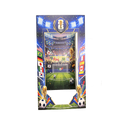
Rather than a repeating logo pattern, full-design backdrops use a single cohesive graphic that fills the entire banner surface — a custom illustration, a brand visual identity expression, a themed design for weddings or personal events, or a photographic background. Full-design backdrops photograph more dynamically than step-and-repeats and create stronger aesthetic impact in photos, but are less optimized for multi-sponsor visibility. They are the stronger choice for weddings, personal celebrations, brand launches with a single brand identity, and any event where photo aesthetic is more important than logo repetition.
Fabric tension displays
Fabric tension displays — printed fabric stretched over an aluminum frame — offer a premium backdrop option with a wrinkle-free surface that photographs exceptionally well. The fabric material eliminates the reflective glare that vinyl banners can produce under direct flash or stage lighting, making them the preferred format for professional photography environments and televised or live-streamed events. The tradeoff is higher cost and more complex setup compared to a standard vinyl banner with a standalone frame or stand.
Retractable roll-up backdrop banners
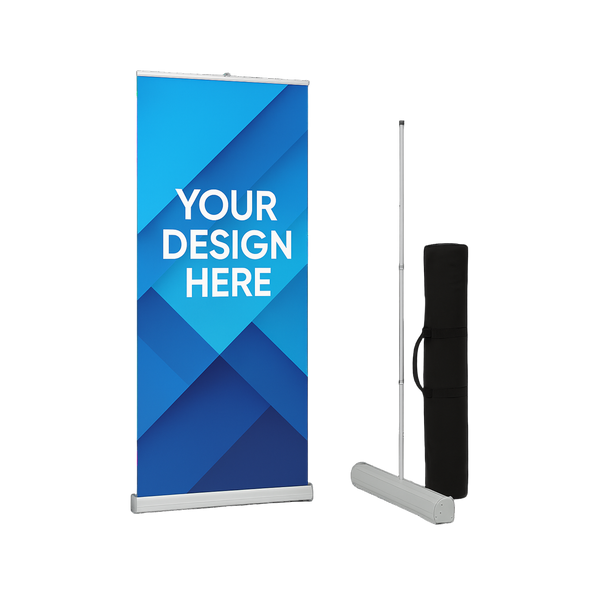
Wide-format retractable banners — typically 60" to 80" wide — serve as portable single-person backdrop solutions for headshot stations, interview setups, and smaller brand activations where a full 8-foot backdrop would be oversized. They set up and break down in under two minutes, transport in a compact case, and are reusable across many events. For businesses that do regular events or conferences, a high-quality retractable backdrop banner is a one-time investment that deploys effortlessly every time.
Standard backdrop banner sizes and what they accommodate
| Size | Best for | Subjects it fits |
|---|---|---|
| 4' × 8' | Single subject headshots, small brand activations, interview backdrops | 1 person, tight crop |
| 6' × 8' | Couples photos, small group shots, portable event setups | 1–2 people comfortably |
| 8' × 8' | Standard step-and-repeat, wedding backdrops, small corporate events | 2–3 people, standard group shot |
| 8' × 10' | Corporate events, trade shows, brand activations, award ceremonies | Most versatile — 3–4 people |
| 8' × 20'+ | Large galas, red carpet events, multi-sponsor displays, stage fronts | Large groups, wide establishing shots |
Event backdrop use cases by event type
Weddings and personal celebrations
Wedding backdrops have shifted from optional to near-standard at modern events. A full-design backdrop at the ceremony or reception photo area — featuring the couple's names, wedding date, and an aesthetic that matches the wedding's visual identity — creates a designated photo location that produces consistent, beautiful images across every guest's camera. The backdrop appears in the official photographer's gallery, in every guest's social posts, and in the wedding album. A floral illustration, a custom monogram design, or a simple elegant logo mark on a clean background are all strong wedding backdrop approaches.
Corporate events and conferences
Step-and-repeat backdrops at conferences, award ceremonies, and corporate galas serve the practical function of ensuring every photo taken at the event contains brand presence. Speaker photos taken in front of a company step-and-repeat carry the brand into press releases, LinkedIn posts, and media coverage. Award recipient photos carry the brand into the award winner's network. The cumulative branded photo content generated by a single well-placed step-and-repeat over the course of a conference day reaches an audience that dwarfs the room itself.
Brand activations and product launches
Brand activations are designed to generate content — and backdrop banners are the infrastructure that ensures that content is branded. A product launch event with a custom backdrop in the brand's visual identity ensures every influencer photo, every press image, and every guest post from the event carries the brand's aesthetic. For brands investing in experiential marketing, a well-designed backdrop is among the highest-leverage investments at the activation because its value scales with every photo taken.
Trade shows and exhibit halls
At trade shows, a backdrop banner behind the exhibit booth serves double duty — it identifies the brand from across the exhibit floor and creates a photo background for product demos, team photos, and client interactions at the booth. An 8' × 10' backdrop behind the booth table creates an enclosed branded environment that reads professionally from a distance. Every photo taken at the booth — by attendees, press, and staff — carries the brand into post-show content across LinkedIn, industry publications, and event recap materials.
Charity galas and fundraising events
Charity events rely heavily on photography for donor recognition, sponsor acknowledgment, and post-event fundraising communications. A step-and-repeat that features the charity's name alongside sponsor logos ensures both the cause and its financial supporters appear in every photo from the event — fulfilling sponsor visibility commitments and generating branded content for post-event newsletters, social media, and annual report materials simultaneously.
Quinceañeras, mitzvahs, and milestone celebrations
Personal milestone events have embraced step-and-repeat and full-design backdrop banners as a standard element of the photo experience. A custom backdrop featuring the celebrant's name, the occasion, and a design that matches the event's color palette and theme creates a centerpiece for the photo area that guests gravitate toward. The backdrop appears in every professional photo and in every guest's social media posts — personalizing the event's visual record in a way that a plain wall or venue background cannot.
How to design a backdrop banner that photographs well
A backdrop banner that looks good in person but washes out, glares, or reads poorly in photos has failed at its primary job. These principles ensure your backdrop performs in the environment where it matters most — inside a camera frame.
- Design for medium contrast — not maximum contrast. Stark white backgrounds behind white-clothed subjects disappear. Jet black backgrounds in low-light venues absorb detail. Medium-toned backgrounds — navy, charcoal, deep green, dusty rose, warm grey — separate subjects clearly and read consistently across lighting conditions.
- For step-and-repeats, size logo instances for the expected crop. Calculate how far the subject will stand from the banner and how wide the photographer's frame will be. Each logo instance should be large enough to read legibly at the crop size common in press photography — roughly 8 to 12 inches wide at the banner's actual dimensions for a standard event.
- Avoid highly reflective design elements if the venue uses flash or direct lighting. Metallic inks and high-gloss finishes on vinyl banners create hotspots under flash photography that wash out the design. Matte or satin finish banners photograph more consistently under mixed lighting conditions typical of event environments.
- Submit files at 100–150 DPI at actual print dimensions. An 8' × 10' backdrop banner needs a source file at 9600 × 12000 pixels at 100 DPI minimum. Files submitted at web resolution will print with visible softness — immediately apparent in any photo taken within normal distance of the backdrop.
- Leave a subject zone — a clear area in the vertical center of the design where subjects will stand. Design elements that crowd the center of the banner compete visually with subjects in photos. The most effective backdrop designs have visual weight at the top (where branding reads over subjects' heads) and the sides, with a relatively clean zone in the middle where people stand.
- For multi-sponsor step-and-repeats, standardize logo sizes. Mixed logo sizes on a step-and-repeat look unpolished and create sponsorship hierarchy disputes. Standardize all logos to the same bounding box size — sponsors that insist on larger treatment can be handled through placement priority (more prominent rows or additional instances) rather than size variation.
Setup, hardware, and practical deployment
A backdrop banner without adequate support hardware fails publicly and immediately. The setup infrastructure is as important as the banner itself.
Backdrop stand systems
A telescoping backdrop stand — adjustable in both height and width — is the most versatile support system for vinyl backdrop banners. Look for stands that accommodate your banner dimensions with at least 6 inches of adjustment room on each side. Heavier vinyl banners require sturdier stand frames — confirm weight capacity before purchasing a stand for large format banners. For indoor events, a quality stand with a crossbar, adjustment clamps, and sandbag anchor points at the base provides secure, professional setup.
Securing against indoor air movement
Indoor events with HVAC, fans, open doors, or heavy foot traffic create air movement that causes unsecured backdrop banners to billow and shift — ruining photos and potentially collapsing the display. Sandbags on stand feet, banner clamps that grip the crossbar tightly, and banner weights along the bottom edge all contribute to a stable, professional display. A banner that moves in every photo is a backdrop that failed at its one job.
Lighting the backdrop
An unlit backdrop in a dimly lit event space reads as a dark smudge behind subjects in photographs. Two uplights or softbox lights aimed at the backdrop surface — not the subjects — ensure the banner's colors and details appear as designed in photos regardless of ambient event lighting. For events with professional photography, coordinate backdrop lighting with the photographer before the event begins.
Order your event backdrop banner at Tawgraphix
Tawgraphix produces full-color custom event banners and backdrop displays with no minimum order requirement, ships across the USA with tracking on every order, and handles everything from single-event wedding backdrops to large-format multi-sponsor step-and-repeat displays.
Upload your design at the correct dimensions
Submit your backdrop design as a PNG at 100–150 DPI at the actual banner dimensions, or as a vector PDF for designs built in Illustrator or similar. Confirm your file dimensions match your intended banner size before submitting. For step-and-repeat designs, submit the full tiled layout — not a single logo instance — so the printed banner matches your intended pattern.
Select your banner size
Choose the size that fits your event space and subject count. The 8' × 10' format is the most versatile for corporate events and brand activations. The 8' × 8' works well for weddings and personal events. Larger formats for galas and red carpet setups are available — confirm your stand hardware accommodates the width you order.
Order with enough lead time for your event
Order at least two to three weeks before your event to allow for production and shipping. For large events where the backdrop is a critical element — galas, conferences, brand launches — order four weeks out and allow time to test your stand setup before the event day. A backdrop that arrives the day before the event with no time to test hardware is an avoidable risk.
Order your custom event backdrop banner at the Tawgraphix custom event banners collection.
Frequently asked questions about event backdrop banners and step-and-repeat displays
A step-and-repeat is a specific type of backdrop banner — one that uses a repeating tiled pattern of logos or brand marks across the full surface so that every photo crop captures at least one readable logo. A backdrop banner is any large-format banner used as a photo background, including full-design backdrops with cohesive graphics, event aesthetics, or custom artwork. Step-and-repeats are optimized for brand and sponsor visibility in photography. Full-design backdrops are optimized for photo aesthetics and event identity.
An 8' × 8' backdrop comfortably fits a couple and accommodates small group shots with immediate family. If you anticipate larger group photos — wedding party shots, family groupings — an 8' × 10' gives more horizontal room and looks proportional in wide-format photos. For ceremony arch backdrops or broader reception feature walls, wider custom sizes are available. The key is matching the banner width to the expected photo frame width at the shooting distance your photographer will use.
Yes — vinyl backdrop banners are designed for repeated use. A corporate step-and-repeat with the company logo deploys at every conference, trade show, and company event indefinitely. A brand activation backdrop reuses across multiple market activations. When designing for reuse, avoid event-specific dates, one-time sponsor acknowledgments, or messaging that will be outdated after a single event. Store rolled rather than folded between events to prevent permanent crease lines that show in photos.
A telescoping backdrop stand with an adjustable crossbar is the standard setup for freestanding vinyl backdrop banners at events. Grommets along the top edge of the banner attach to the crossbar with S-hooks or zip ties. Sandbags on the stand feet prevent tipping in air-conditioned venues with significant air movement. For venues with exposed ceiling structures — warehouses, lofts, event tents — the banner can also be suspended from rigging points using the top grommets. Confirm your stand's height capacity matches your banner height before the event.
For full-design backdrops with photography or complex artwork, submit a PNG at 100–150 DPI at the actual banner dimensions. For step-and-repeat designs built with vector logos and text, submit a PDF with fonts outlined and linked images embedded. Avoid submitting a single-logo file and asking for the step-and-repeat pattern to be built in production — submit the full tiled layout as you want it to print. If your logo files are vector-based, a vector PDF of the full layout ensures maximum sharpness at any print size.
Order at least three to four weeks before your event. Corporate events typically have fixed, immovable dates and the backdrop is often a critical element of the event's photo and branding infrastructure. Four weeks provides buffer for production, shipping, a test setup at your venue or office, and any adjustments if something is not right before the event day. Ordering a week before the event and hoping for the best is a risk not worth taking for an event where the photo content matters to the brand.