






Trade show banner sizing isn't arbitrary — it's determined by the booth dimensions assigned to you, the display format you're using, the viewing distance from the aisle, and how many display elements you're working with. A banner that's the right size commands the back wall of your booth, fills the space without gaps, and makes your brand legible from 20 feet away in a crowded exhibit hall. A banner that's the wrong size — too narrow, too short, or the wrong aspect ratio for the stand — looks like it belongs in a different booth.
This guide covers the correct banner sizes for every trade show display format: back wall backdrops, retractable banners, table banners, hanging signs, and multi-panel configurations. The dimensions here match the most common booth sizes — 10x10, 10x20, and inline configurations — and the standard hardware those booths use.
Always confirm your booth dimensions and any venue restrictions before ordering banners. Some venues have height restrictions, hanging sign regulations, and aisle setback rules that affect what you can display and where. Ordering to the wrong dimensions means reprinting.
Back Wall Backdrop Banners
The back wall backdrop is the most important banner in any trade show booth. It's what visitors see from the aisle before they approach, it sets the visual context for every conversation that happens at the booth, and it's the background in every photo taken at your display. Getting this banner right — the right size, the right design, the right resolution — is the single highest-impact decision in trade show display.
For a standard 10x10 foot booth, the back wall is 10 feet wide and typically 8 feet tall. A backdrop banner sized at 10 feet wide by 8 feet tall fills it completely. In practice, most exhibitors order a banner slightly narrower — 9.5 feet wide — to allow for easy installation without the banner overhanging the side walls or requiring precise trimming on site. Height is usually ordered at 7.5 to 8 feet to clear the floor and reach close to the top of the booth structure.
For a 10x20 foot booth, the back wall doubles to 20 feet wide. Most exhibitors cover this with two 10-foot-wide backdrop panels side by side rather than a single 20-foot banner, which would be unwieldy to transport and install. Design the two panels as a continuous graphic that splits cleanly down the center, with the seam falling in a neutral area of the background.
10x10 booth back wall
Standard size: 9.5–10 feet wide by 7.5–8 feet tall. A single panel covers the full back wall. Design as a landscape-oriented graphic with the logo and headline in the upper center where they're visible above table height from the aisle.
10x20 booth back wall
Standard size: two panels at 9.5–10 feet wide by 7.5–8 feet tall each. Design as one continuous graphic split at the center seam. Alternatively, use three retractable banners or a tension fabric display system sized for the wider back wall.
Inline or island booths
Island booths (open on all four sides) use hanging signs overhead and perimeter displays rather than a single back wall. For inline booths with one shared back wall, size the banner to the full wall width assigned — typically measured in 10-foot increments based on the number of booth spaces combined.
Retractable Banner Sizes for Trade Shows
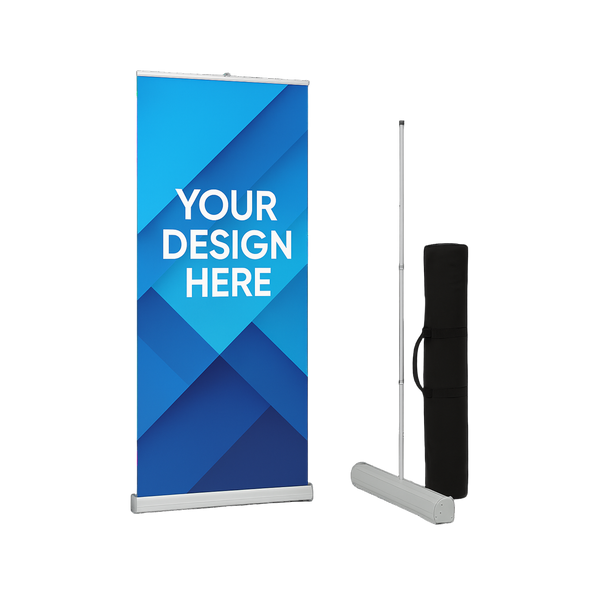
Retractable banners are the most portable and self-contained display format for trade shows — no wall needed, no tools, setup in under two minutes. The size options are constrained by the cassette hardware, but within that range there's enough flexibility to match most booth configurations.
The standard retractable banner size for trade show use is 33 inches wide by 80 inches tall. This is the most common configuration — wide enough for a full logo and supporting content, tall enough to be visible above the crowd and table level. Some exhibitors prefer a 36-inch-wide unit for a bit more design space, or step up to a wide-format unit at 47–60 inches wide for a larger visual presence without a full back wall backdrop.
For a 10x10 booth, two or three standard retractable banners along the back wall — spaced evenly — create a branded environment without requiring a frame or wall mounting system. Three 33-inch retractables side by side cover approximately 99 inches — just over 8 feet — of back wall width, leaving a few inches of clearance on each side. For a side wall or aisle-facing display, a single retractable at the front corner of the booth draws attention from passersby without blocking booth access.
| Retractable Size | Best Use | Booth Fit | Notes |
|---|---|---|---|
| 33" x 80" | Standard trade show | 10x10 (2–3 units), 10x20 (3–4 units) | Most common size — widest hardware and graphic availability |
| 36" x 80" | More design space | 10x10 (2 units), 10x20 (3 units) | Slightly wider canvas — good for complex logos or imagery |
| 47"–60" x 80" | Wide-format single panel | 10x10 (1–2 units) | Larger presence — fewer units needed to cover back wall |
| 11"–12" x 17"–20" | Tabletop display | Counter or table surface | Small format for close-up product or brand information |
Table Banners and Table Throws
The table at the front of a trade show booth is a display surface in its own right. A printed table throw or table banner transforms a generic folding table into a branded element that reinforces the visual identity of the booth from floor to tabletop. Visitors standing at the table see the printed surface directly — it's a close-up branding touchpoint in a way that the back wall banner isn't.
Standard trade show tables are 6 feet or 8 feet long and 30 inches tall. A full-length table throw that covers the front face and hangs to the floor is the cleanest option — it hides the table legs and any storage underneath while presenting an uninterrupted branded surface. Table runner banners — narrower panels that sit on top of the table rather than draping over it — are a lower-cost alternative that adds branding without fully covering the table.
For table-top retractable banners used on the table surface rather than floor-standing, the 11x17 or 12x20 inch tabletop format sits within arm's reach of visitors and works well for product details, pricing information, or a secondary brand message that the back wall banner doesn't have room for.
Hanging Signs and Overhead Displays
For island booths and larger configurations, overhead hanging signs suspended from the venue ceiling are the highest-visibility display element in the exhibit hall — visible from across the room in a way that floor-level displays can't match. Most trade show venues that allow hanging signs specify a maximum size and weight, and require advance notice for rigging — check the show's exhibitor manual before designing an overhead sign.
Common hanging sign shapes are rectangle, circle, square, and triangle. Rectangular hanging banners in a landscape orientation are typically 4 feet tall by 8 feet wide — large enough to display a logo and company name clearly from a distance. Double-sided printing is standard for hanging signs since they're visible from multiple directions. Single-sided hanging signs waste the back face that visitors approaching from behind will see.
Hanging signs require advance coordination with the show's rigging crew — they can't be installed by exhibitors in most venues. Submit rigging requests by the show's deadline, which is often weeks before the event. Late requests are frequently denied.
Banner Sizes by Booth Configuration
| Booth Type | Back Wall Banner | Retractable Count | Table Banner | Hanging Sign |
|---|---|---|---|---|
| 10x10 Standard | 9.5–10' x 7.5–8' | 2–3 at 33" | 6' table throw | Usually not permitted |
| 10x20 Double | Two panels at 9.5–10' x 7.5–8' | 3–4 at 33" | 6' or 8' table throw | 4'x8' double-sided |
| 10x30 Triple | Three panels at 9.5–10' x 7.5–8' | 4–6 at 33" | 8' table throw | 4'x8' double-sided |
| Island (20x20) | Perimeter panels or no back wall | 4–6 at sides | Multiple table throws | 4'x8' or larger — essential |
| Tabletop Display | Not applicable | 1–2 tabletop units | 6' table throw | Not applicable |
Design Specs for Trade Show Banners
- Submit large-format backdrop banners at 150 DPI at full print size — 300 DPI is not required for banners viewed from 10+ feet away and creates unnecessarily large files
- Include at least 0.5 inches of bleed on all edges — banners are trimmed after printing and bleed prevents white edges from appearing
- Keep critical text and logos at least 2 inches from all edges — grommet holes, hem seams, and installation can obscure content near the border
- Use a minimum headline font size of 3 inches tall at print size — this ensures legibility from 30 feet across an exhibit hall aisle
- Set color mode to CMYK before exporting — RGB files produce color shifts in large-format print output, especially in blues and purples
- For multi-panel backdrops, design as a single file and divide at the seam — never design panels independently and try to align them afterward
- Place the seam on multi-panel backdrops in a neutral background area — never through a logo, face, or critical design element
Frequently Asked Questions
For a back wall backdrop banner in a 10x10 booth, 9.5 to 10 feet wide by 7.5 to 8 feet tall is the standard. This fills the full back wall with minimal gap at the sides and clears the floor and ceiling of the booth structure. For retractable banners instead of a full backdrop, two to three 33-inch-wide units along the back wall cover the space effectively. Always confirm actual booth dimensions with the show organizer — "10x10" is nominal and actual wall dimensions sometimes vary.
Most trade show booth structures have a back wall height of 8 feet. Backdrop banners are typically ordered at 7.5 to 8 feet tall to fill that height. Retractable banners are constrained by the cassette hardware — standard retractable units display at 79 to 84 inches (approximately 6.5 to 7 feet) of visible graphic height, which sits slightly below the 8-foot booth ceiling but fills the visible range above table height effectively. For venues with higher ceilings or elevated booth structures, confirm the actual usable height before ordering.
For a 10x10 booth, two to three retractable banners is the most common configuration. Two 33-inch units side by side at the back wall cover about 66 inches — leaving visible gaps on each side. Three units cover 99 inches — nearly the full 10-foot back wall width with a few inches of clearance. If budget allows three, they look more complete. A fourth unit at the front corner of the booth draws aisle attention without blocking access. For a 10x20 booth, four to six units are appropriate depending on the design and layout.
A full backdrop banner creates a more seamless, immersive branded environment — the entire back wall becomes a single graphic. Retractable banners create a branded environment with individual vertical panels — more flexible and portable but with visible gaps between units. The right choice depends on how often the display travels and how important seamless back wall coverage is. For companies that exhibit frequently and need fast, reliable solo setup, retractable banners are the practical choice. For companies that exhibit less frequently and want the most polished back wall appearance, a backdrop banner system or tension fabric display delivers a more refined result.
150 DPI at the full print size is the industry standard for large-format trade show banners. Banners are viewed from a distance — typically 10 to 30 feet across an aisle — where the extra resolution of 300 DPI isn't perceptible to the human eye but adds significant file size. If your design includes very detailed photography or fine illustration, 200 DPI at full size is a reasonable middle ground. Never design at the full size at 72 DPI (screen resolution) — the output will look noticeably soft even at trade show viewing distances.
Yes — trade show banners are designed for repeated use. Retractable banners in particular are built for this: roll up, pack in the carry bag, transport to the next show. Vinyl backdrop banners can be rolled for transport and reused many times if handled carefully — avoid sharp folds, store rolled rather than flat, and keep them away from moisture between events. The main reason to reprint is updated branding, messaging changes, or physical wear from repeated use rather than any inherent limitation on reuse.
Tawgraphix offers custom event banners in sizes suited for trade show applications. Submit your artwork at 150 DPI at the full print size in PDF or PNG format with bleed included. If you need a specific size for your booth configuration or have questions about finish options — grommets, pole pockets, or hem specifications — confirm the details before submitting your file to make sure the banner arrives ready to install at your show.